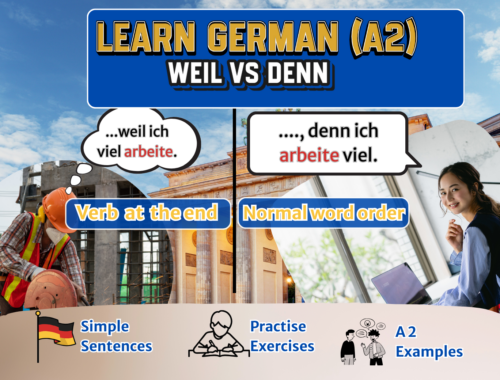
Weil vs Denn in German (A2): How to Give Reasons Simply
At A2 level, learners want to say more than just what they feel or do.They also want to explain why. In German, the two most common words to give a reason are weil and denn.Both mean because, but they are…
How to Talk About Feelings and First Impressions in German (A2)
When you reach A2 level in German, you can already talk about simple topics like your name, your job, or your daily routine.At this level, learners often want to say more: how they feel, what is new or difficult, and…
A2 German Explained: What You Learn and How to Progress
If you are learning German and already know some basics, you may be at A2 level.But what does A2 really mean, and what should you be able to do at this stage? In this guide, you’ll learn: This article also…
Weather and Seasons in German (A1): Simple Vocabulary & Examples
Talking about the weather and the seasons is one of the most common topics at A1 level. You use it to make small talk, describe daily life, and talk about plans. In this guide, you’ll learn: This topic works best…
A1 German Modal Verbs Explained (können, müssen, wollen & möchten)
German modal verbs are essential at A1 level because they help you express: You will hear modal verbs in almost every everyday German conversation. At A1 level, the goal is clear communication, not perfect grammar. If you’re completely new to…
A1 German Pronunciation Guide (Alphabet, Sounds & Common Mistakes)
German pronunciation often feels intimidating for beginners, especially because some sounds do not exist in English. The good news is that German pronunciation is logical and consistent. Once you learn the basic rules, most words are pronounced exactly as written.…
German Cases Explained Simply (A1–A2 Beginners)
When learning German, many beginners notice something confusing very quickly:articles and words seem to change, even though the meaning stays the same. This happens because German uses cases. If you’re new to grammar, don’t worry — at A1 level, you…
How to Introduce Yourself in German
Being able to introduce yourself in German is one of the very first and most important skills at A1 level. Whether you’re meeting new people, registering for a course, visiting an office, or preparing for an exam, this is something…
Negation in German
nicht vs kein Explained Simply One of the first things learners want to do in German is say “no”, “not”, or “don’t”.At A1 level, this is easier than it looks — German mainly uses two words for negation: 👉 nicht👉…
German Verb Conjugation Explained
German verb conjugation is one of the most important grammar topics at A1 level. The good news is that German verb forms follow clear and logical patterns, and once you understand them, forming sentences becomes much easier. If you’re just…