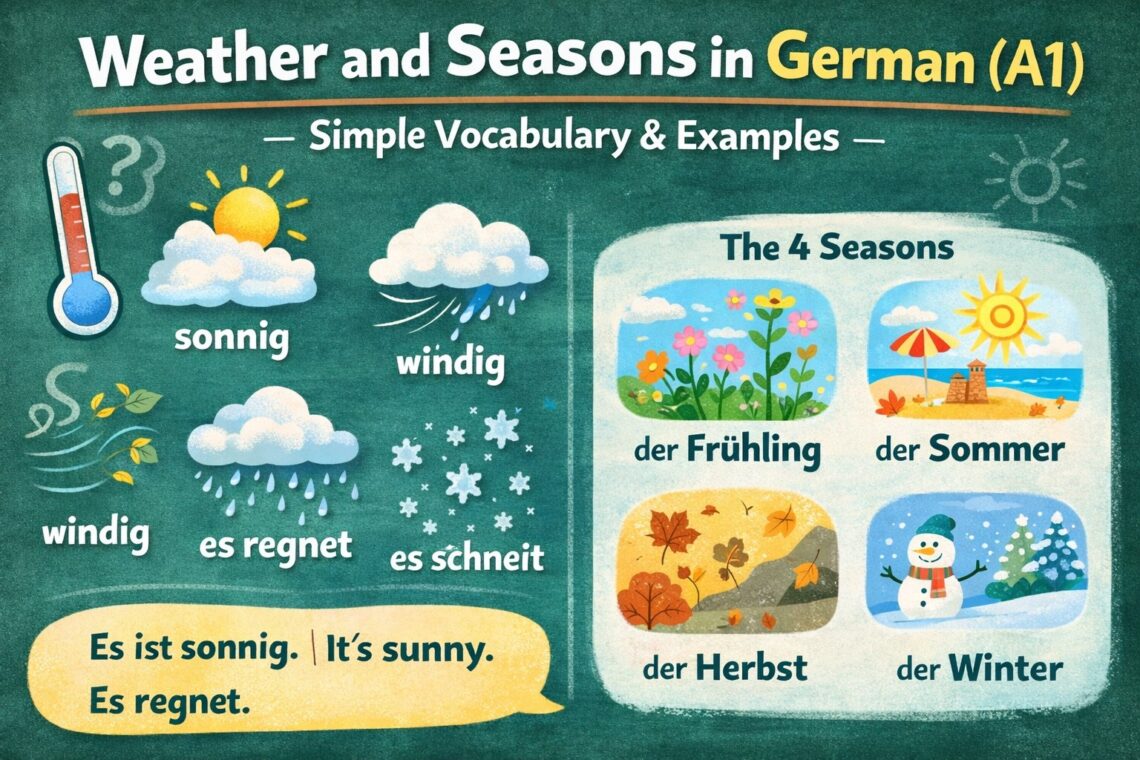
Weather and Seasons in German (A1): Simple Vocabulary & Examples
Talking about the weather and the seasons is one of the most common topics at A1 level. You use it to make small talk, describe daily life, and talk about plans.
In this guide, you’ll learn:
- Basic German weather expressions
- The four seasons in German
- Simple example sentences
- How to talk about weather at A1 level
This topic works best when you already know A1 German basics, because weather sentences follow very clear patterns.
To hear pronunciation and natural usage, learners can watch German weather and seasons vocabulary for beginners (A1).
Talking About the Weather in German (A1)
In German, weather sentences often start with “es”.
Examples:
- Es ist kalt. (It is cold.)
- Es regnet. (It is raining.)
- Es ist sonnig. (It is sunny.)
Common Weather Conditions in German (A1)
Here are the most important weather words you need at A1 level:
| German | English |
|---|---|
| sonnig | sunny |
| regnerisch | rainy |
| windig | windy |
| kalt | cold |
| warm | warm |
| heiß | hot |
| bewölkt | cloudy |
| es regnet | it’s raining |
| es schneit | it’s snowing |
Example sentences:
- Heute ist es kalt.
- Es ist warm und sonnig.
- Im Winter schneit es oft.
These sentences use simple German sentence structure, which makes them ideal for beginners.
The Four Seasons in German
German has four seasons, just like English.
| German | English |
|---|---|
| der Frühling | spring |
| der Sommer | summer |
| der Herbst | autumn |
| der Winter | winter |
These nouns use articles, which connects this topic naturally to German articles der, die, das.
Talking About Seasons in Simple Sentences
At A1 level, you can combine seasons with weather and time expressions.
Examples:
- Im Sommer ist es heiß.
- Im Winter ist es kalt.
- Im Frühling regnet es oft.
- Im Herbst ist es windig.
These sentences are excellent practice for:
- Weather vocabulary
- Prepositions
- Word order
They also appear frequently in A1 speaking tasks.
Weather and Daily Life (A1 Speaking)
Weather is often used for small talk.
Simple questions you can ask:
- Wie ist das Wetter?
- Ist es kalt oder warm?
Simple answers:
- Es ist sonnig.
- Es ist kalt heute.
Being able to answer these questions confidently helps when introducing yourself in German and talking about everyday topics.
Weather and Seasons in the A1 Exam
In the A1 exam, weather and seasons may appear in:
- Reading texts
- Listening tasks
- Speaking questions
For example:
Wie ist das Wetter heute?
Welche Jahreszeit mögen Sie?
Understanding this topic supports your preparation for the exam, especially if you are working towards How to pass the A1 German exam.
Mini Practice Exercises (A1)
✍️ Exercise 1: Choose the correct word
- Im Sommer ist es ___ (kalt / heiß).
- Im Winter ___ es oft. (regnet / schneit)
Answers:
- heiß
- schneit
✍️ Exercise 2: Build sentences
Use the words:
- Sommer / sonnig
- Winter / kalt
Possible answers:
- Im Sommer ist es sonnig.
- Im Winter ist es kalt.
Practising short sentences like these is part of effective A1 German practice exercises.
Useful Tip for A1 Learners
Weather sentences are short, repetitive, and predictable.
This makes them perfect for:
- Speaking practice
- Listening practice
- Building confidence
The more you see and hear these patterns, the more natural they will feel.
Summary: Weather and Seasons at A1
At A1 level, you should be able to:
- Name basic weather conditions
- Talk about the four seasons
- Use simple sentences with es ist
- Understand weather questions in daily life
This topic combines vocabulary, grammar, and speaking in a very natural way.
What Comes Next?
After mastering weather and seasons, learners often move on to:
- Talking about daily routines
- Making plans
- Describing activities
All of these topics build on the same basic sentence patterns.


You May Also Like

German Verb Conjugation Explained

A1 German Basics: How to Start Learning German.