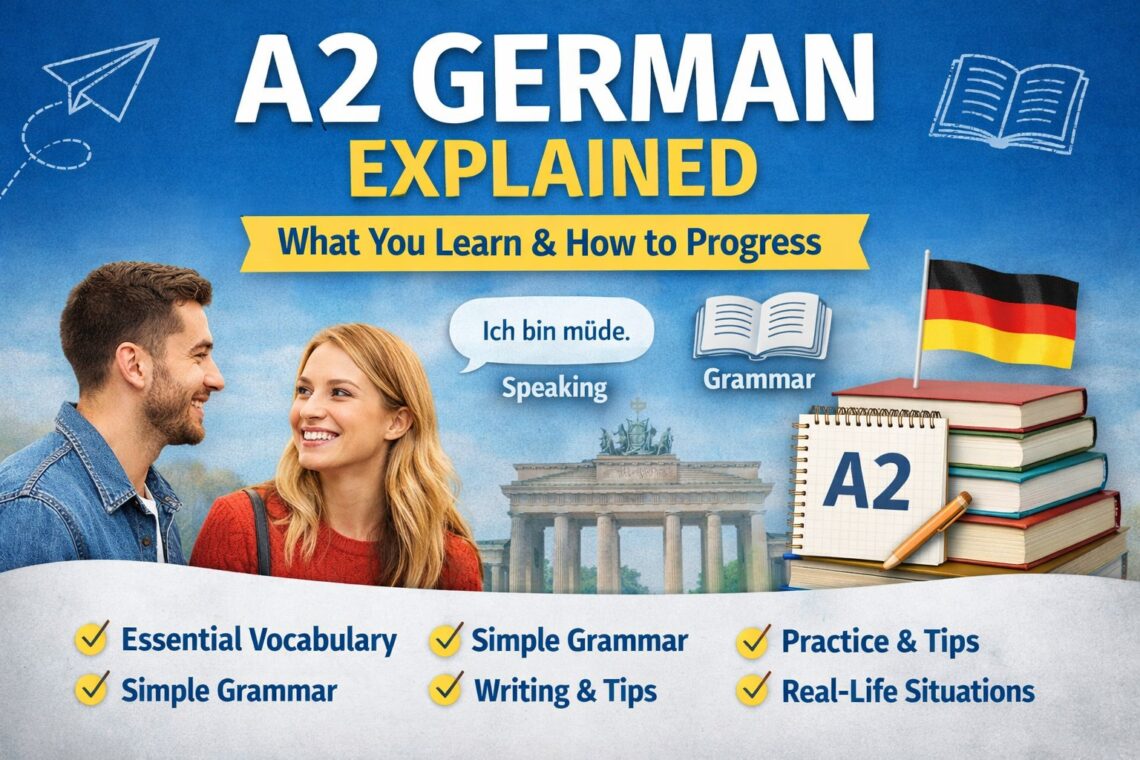
A2 German Explained: What You Learn and How to Progress
If you are learning German and already know some basics, you may be at A2 level.
But what does A2 really mean, and what should you be able to do at this stage?
In this guide, you’ll learn:
- what A2 German is
- what skills A2 learners should have
- what grammar and topics are typical at A2
- how to learn German at A2 step by step
This article also links to practical A2 lessons and explanations you can use right away.
1. What Is A2 German?
A2 is the second level of the Common European Framework of Reference for Languages (CEFR).
At this level, learners move beyond basic phrases and start to communicate more independently.
At A2 level, you can:
- talk about everyday topics
- understand simple conversations
- write short texts
- explain simple reasons and experiences
A2 is often called the “survival plus” level, because you can manage many daily situations.
2. What Can You Do at A2 Level?
Here are some things A2 learners can typically do:
🗣️ Speaking
- talk about how you feel
- describe your home and daily life
- explain simple reasons
👉 You can see examples in our post on
talking about feelings and first impressions in German (A2).
👂 Listening
- understand short conversations
- follow simple explanations
- catch key information
Listening is often connected to everyday situations, like work or travel.
✍️ Writing
- write short emails and messages
- fill out forms
- describe experiences
A2 writing focuses on clarity, not long texts.
📖 Reading
- understand short texts
- read emails, notices, and ads
- find important information
3. Typical Grammar Topics at A2 Level
At A2, learners focus on grammar that helps them communicate clearly, not on complex rules.
Common A2 grammar topics include:
- talking about the past (Perfekt)
- giving reasons (weil, denn)
- asking polite questions
- describing places and people
👉 For example, you can learn how to explain reasons in our guide to
weil vs denn in German (A2).
👉 To talk about past experiences, see our explanation of
the Perfekt tense at A2 level.
4. Typical Topics You Learn at A2
A2 German is built around real-life topics, such as:
- arriving in a new place
- home and living
- food and daily habits
- work and free time
- travel and services
These topics help you use German in real situations, not just in exercises.
5. How to Learn German at A2 Level Successfully
Many learners struggle at A2 because they try to learn too much at once.
Here are some tips:
- focus on short, correct sentences
- practice speaking every day
- learn vocabulary in context
- repeat grammar in small steps
👉 Our A2 lessons and explanations are designed to support exactly this approach.
6. A2 German and Exams
Many learners study A2 German to prepare for exams such as:
- Goethe-Zertifikat A2
- TELC A2
- ÖSD A2
At A2 level, exams test:
- everyday vocabulary
- simple grammar
- clear communication
Understanding how A2 works is the first step to exam success.
7. How This A2 Guide Is Structured
On this website, A2 content is organised to help you progress step by step.
You will find:
- clear grammar explanations
- speaking and writing practice
- real-life examples
- video-supported lessons
You can start with:
- talking about feelings and first impressions in German (A2)
- giving reasons with weil and denn (A2)
- talking about past experiences in German (A2)
Each topic builds on the previous one.
Learn German Step by Step
If you want a structured A2 German course with:
- video lessons
- vocabulary lists
- workbooks and quizzes
- speaking and writing practice
you can explore my full A2 German course, designed for learners who want clear progress.


You May Also Like
A1 German Listening Practice

A1 German Daily Routine Vocabulary