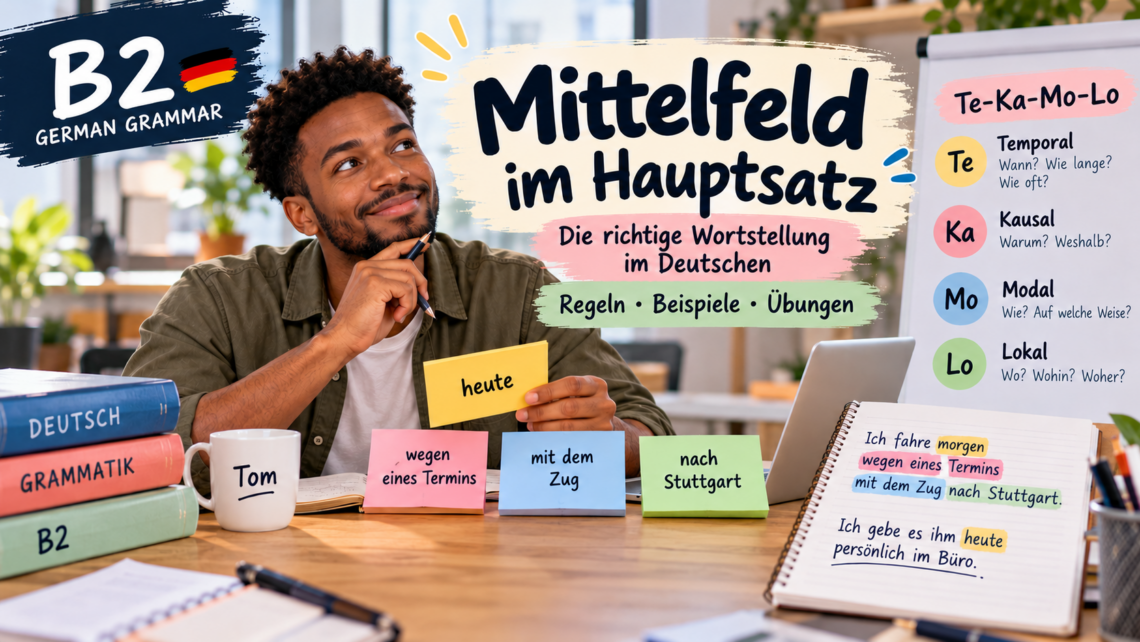
Mittelfeld im Hauptsatz: Die richtige Wortstellung im Deutschen (B2)
October 25, 2026Share this lesson1. What is the Mittelfeld in German? Have you ever tried to build a long German sentence and wondered where to put the time, the reason, the manner, the place and the objects? You are not alone! German word order can be challenging, especially when you want to express several ideas in one grammatically correct sentence. The good news is that there are patterns you can learn and practise. In German grammar, a main clause (Hauptsatz) can be divided into different parts. Three important concepts are: Consider this example: Ich habe meinem Kollegen gestern wegen eines wichtigen Projekts…
Zweiteilige Konnektoren im Deutschen: B2-Grammatik einfach erklärt
Share this lesson1. What are zweiteilige Konnektoren? Zweiteilige Konnektoren, also called zweiteilige Konjunktionen or paired conjunctions, are expressions made up of two parts that work together to connect words, phrases or clauses. They help you express relationships such as addition,…
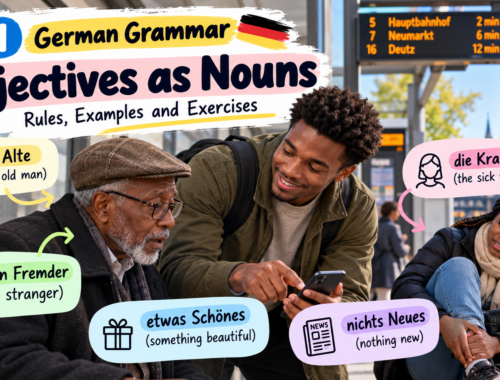
B1 German Grammar: Adjectives as Nouns (Nominalisierte Adjektive) – Rules, Examples and Exercises
Share this lessonHave you ever seen German expressions such as der Alte, die Kranke or das Gute and wondered why an adjective suddenly looks like a noun? At B1 level, you need to understand how German adjectives can be used…
B1 German Grammar: Comparatives, Superlatives and „Außer + Dativ“ (With Examples and Exercises)
Share this lessonHave you ever wanted to explain why one place is more beautiful than another, describe the best experience you have ever had, or explain who is allowed to participate in an activity? At B1 level, you need more…
B1 German Grammar: How to Use „Je … desto“ and „Je … umso“ (With Examples and Exercises)
Share this lessonHave you ever wanted to say, “The more you practise, the better you become” in German? At B1 level, you need structures that help you express relationships between actions, changes, and results. One of the most useful German…
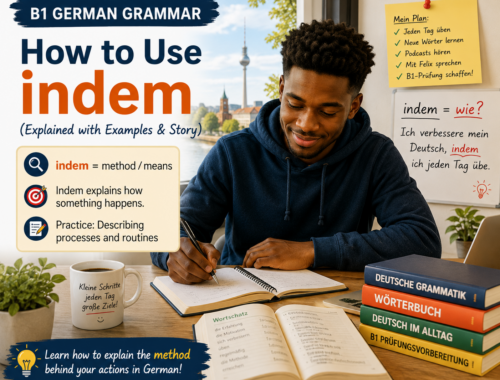
B1 German: How to Use „indem“ (Explained with Examples & Story)
Share this lessonIntroduction In this lesson, you will learn how to use indem. Indem is used to explain how something happens or the method someone uses to achieve a goal. It is one of the most useful conjunctions at B1…
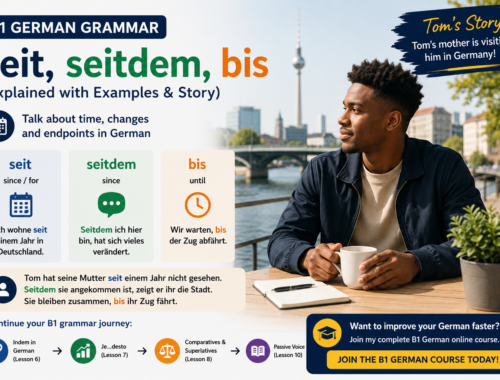
B1 German: How to Use „seit“, „seitdem“ and „bis“ (Explained with Examples & Story)
Share this lessonIntroduction In this lesson, you will learn how to use: These structures are useful when talking about: To make the grammar easier and more interesting, we will continue Tom’s story. 👉 Before reading this lesson, make sure you…
B1 German: Adjectives as Nouns & Present Participles (Explained with Examples & Story)
Share this lessonIntroduction In this lesson, you will learn how to use: These structures are very common in newspapers, formal German, books, and B1-level writing. To make the grammar easier and more interesting, we will continue Tom’s story. 👉 Before…
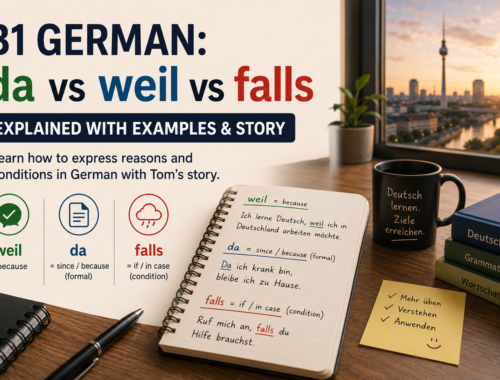
B1 German: da vs weil vs falls (Explained with Examples & Story)
Share this lessonIntroduction In this lesson, you will learn how to use: These conjunctions help you explain reasons, describe situations, and talk about conditions — all very important skills at B1 level. To make the grammar easier and more interesting,…
B1 German Grammar: wegen + Genitiv and trotz + Genitiv (Learn Through Story – Tom in Germany)
Share this lessonIntroduction At B1 level, learning German is not just about memorizing rules. It’s about understanding how people actually live, work, and communicate in real situations. In this lesson, you’ll learn how to express: But instead of isolated sentences,…
B1 German Grammar: Verbs with Prepositions & “da-Words” Explained (With Examples)
Share this lessonIntroduction One of the biggest challenges for learners at B1 level is using verbs with the correct prepositions. Many learners say:❌ Ich warte den BusBut in German, this is incorrect. The correct sentence is:✅ Ich warte auf den…