A1 German Pronouns Explained Simply
German pronouns are one of the first grammar topics every beginner needs. They allow you to talk about yourself, other people, and everyday situations using simple sentences.
If you’re completely new to German, start with our A1 German basics guide to understand how pronouns fit into beginner-level sentences.
In this guide, you’ll learn German personal pronouns at A1 level, how to use them correctly, and how to avoid common beginner mistakes — with clear examples and practice exercises.
If you prefer learning with spoken examples and pronunciation, you can watch the video on German Pronouns here.
What Are Pronouns in German?
Pronouns are small words that replace nouns or refer to people and things.
In English:
- I am learning German.
- She lives in Berlin.
In German, pronouns work in a similar way — but they change depending on person and number.
At A1 level, you mainly need personal pronouns in the nominative case (used for the subject of a sentence).
Pronouns are always used as part of a sentence, so understanding simple German sentence structure is essential.
German Personal Pronouns (A1 – Nominative Case)
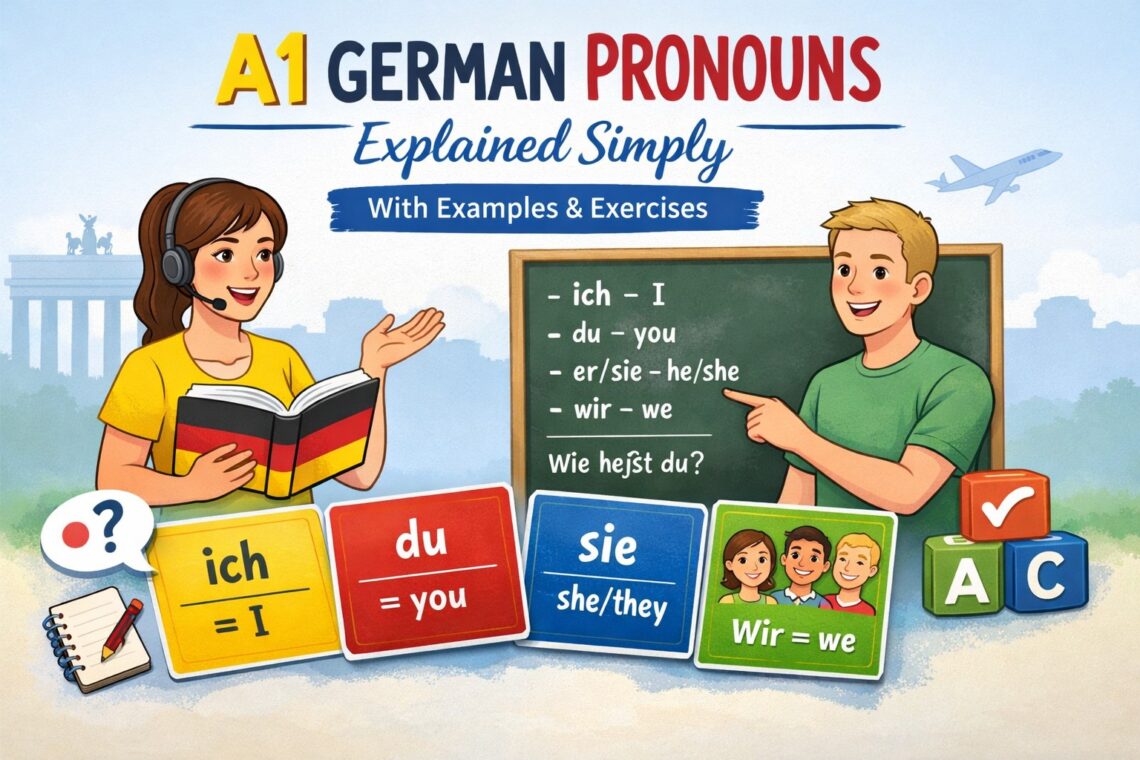
Here are the most important German pronouns you need as a beginner:
| German | English |
|---|---|
| ich | I |
| du | you (informal singular) |
| er | he |
| sie | she |
| es | it |
| wir | we |
| ihr | you (informal plural) |
| Sie/sie | you (formal)/ they (plural) |
At A1 level, it’s also important to understand that personal pronouns are just one group among the different types of pronouns in German.
📌 Important:
- sie can mean she or they (context matters)
- Sie (formal “you”) is always capitalised
How to Use German Pronouns in Sentences
German sentence structure at A1 is usually:
Pronoun + verb + rest of sentence
Examples:
- Ich heiße Paul.
(My name is Paul.) - Er wohnt in Harare.
(He lives in Harare.) - Wir gehen in den Park.
(We are going to the park.)
You’ll notice that the verb changes depending on the pronoun, which is explained in more detail in our guide to present tense German verbs for beginners.
📌 The verb changes depending on the pronoun — this is called verb conjugation.
Formal vs Informal “You” in German
German has two types of “you”, which is very important culturally.
🔹 Informal
- du → one person (friend, family, child)
- ihr → more than one person
🔹 Formal
- Sie → one or more people (strangers, colleagues, official situations)
Examples:
- Du bist Student. (informal) (You are a student)
- Sie sind Student. (formal) (You are a student)
📌 When in doubt, use “Sie” — it’s polite and safe.
Knowing when to use du or Sie is especially important when introducing yourself in German.
Common Beginner Mistakes with German Pronouns
🚫 Using du with strangers
🚫 Forgetting to capitalise Sie
🚫 Mixing English word order
🚫 Forgetting to change the verb
Incorrect:
Ich lernen Deutsch.
Correct:
Ich lerne Deutsch.
Many of these mistakes become easier to avoid once you practise with structured A1 German exercises.
Pronouns + Common A1 Verbs (Examples)
Here are some verbs beginners often use:
| Pronoun | lernen (to learn) | wohnen (to live) |
|---|---|---|
| ich | lerne | wohne |
| du | lernst | wohnst |
| er/sie/es | lernt | wohnt |
| wir | lernen | wohnen |
| ihr | lernt | wohnt |
| Sie/sie | lernen | wohnen |
📌 Don’t memorise everything at once — patterns become clear with practice.
Practice Section (Very Important)
✍️ Exercise 1: Choose the correct pronoun
- ___ lerne Mathe. (I)
- ___ gehst Spazieren. (you – informal)
- ___ kochen. (we)
✍️ Exercise 2: Complete the sentences
- ___ heiße Victor.
- ___ sind Lehrer. (formal)
- ___ lernt English. (he)
To practise pronouns in real-life contexts, learn them together with everyday expressions from our list of essential German phrases for beginners.
How Pronouns Fit Into A1 Learning
Pronouns are essential for:
- Introducing yourself
- Talking about daily life
- Building simple sentences
- Speaking with confidence
They are a foundation topic in courses and exams defined by institutions such as the Goethe-Institut.
Once you master pronouns, everything else becomes easier.
What to Learn Next After Pronouns (A1)
After this topic, continue with:
- Simple German sentence structure
- Present tense verbs
- Articles (der, die, das)
- Asking questions
These topics naturally build on pronouns.
Final Thoughts
German pronouns may look simple, but they are powerful building blocks. At A1 level, focus on:
- Using them correctly
- Matching the verb
- Practising them in real sentences
With regular practice, pronouns will soon feel natural — and your confidence in German will grow quickly.
Once you feel confident using pronouns and basic grammar, the next step for many learners is preparing for an official exam.


You May Also Like
A1 German Numbers, Time and Dates

German Cases Explained Simply (A1–A2 Beginners)