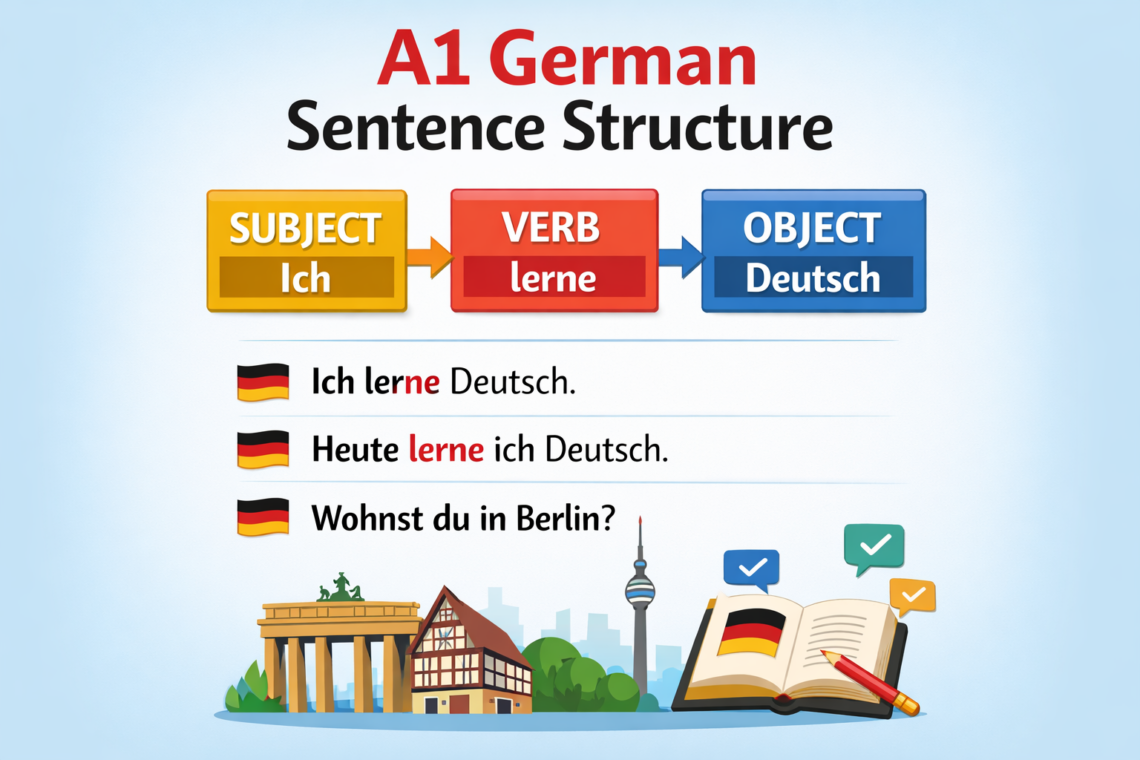
A1 German Sentence Structure Explained
One of the biggest challenges for beginners learning German is sentence structure. German word order looks similar to English at first, but small differences — especially verb position — can be confusing.
The good news?
At A1 level, German sentence structure is very systematic and predictable. Once you understand a few simple rules, you can start building correct sentences with confidence.
If you’re just starting to learn German, it helps to first understand the overall structure of the A1 German basics for complete beginners.
This guide explains German sentence structure step by step, with clear examples and beginner exercises.
If you prefer learning with video, this topic is explained in detail in our YouTube lesson with clear examples and visuals.
What Is Sentence Structure in German?
Sentence structure means the order of words in a sentence — especially:
- Where the verb goes
- Where time, place, and objects go
In German, the verb position is the most important rule.
The Most Important Rule at A1 Level
👉 The verb is in position 2
In a normal German statement, the conjugated verb is always in position 2.
Basic structure:
Position 1 + Verb + Rest of sentence
This rule becomes much easier once you understand how German verbs for beginners work in the present tense.
Examples:
- Ich lerne Deutsch.
- Ich wohne in Berlin.
- Ich arbeite heute.
Even if position 1 changes, the verb stays in position 2.
Simple German Sentence Pattern (A1)
Standard pattern:
Subject + Verb + Object
Examples:
- Ich trinke Kaffee.
- Wir lernen Deutsch.
- Sie liest ein Buch.
To use this structure correctly, you also need to know which German personal pronoun to use.
This pattern is perfect for beginners and works in most everyday situations.
What Can Be in Position 1?
Position 1 does not always have to be the subject.
At A1 level, position 1 can be:
- The subject
- A time expression
- A place expression
But remember: the verb must still be in position 2.
Example 1: Subject first
Ich lerne Deutsch.
Example 2: Time first
Heute lerne ich Deutsch.
Example 3: Place first
In Berlin lerne ich Deutsch.
📌 Notice how ich moves after the verb when something else comes first.
Sentence Structure with Time and Place (A1 Rule)
A common A1 structure is:
Time – Verb – Subject – Place – Rest
Examples:
- Heute lerne ich Deutsch.
- Am Montag arbeite ich zu Hause.
- Am Morgen trinke ich Kaffee.
You don’t need to memorise long rules — just remember:
Verb stays in position 2.
Time expressions like heute and am Morgen appear very often at A1 German daily routine vocabulary level.
Yes/No Questions in German (A1)
For yes/no questions, the verb comes first.
Structure:
Verb + Subject + Rest?
Examples:
- Lernst du Deutsch?
- Kommst du aus Uganda?
- Arbeitest du heute?
Asking simple questions in German is one of the most important speaking skills for beginners.
📌 These are very common in daily conversations.
W-Questions in German (A1)
W-questions begin with words like:
- Was (what)
- Wo (where)
- Wann (when)
- Wie (how)
Structure:
Question word + Verb + Subject + Rest
Examples:
- Wo wohnst du?
- Was lernst du?
- Wie heißt du?
Again: the verb is in position 2.
These question words are part of the essential German phrases for A1 beginners should master early.
Common A1 Sentence Structure Mistakes
🚫 Ich Deutsch lerne.
✅ Ich lerne Deutsch.
🚫 Heute ich lerne Deutsch.
✅ Heute lerne ich Deutsch.
🚫 Du lernst Deutsch heute?
✅ Lernst du heute Deutsch?
These mistakes are normal — focus on verb position, not perfection.
✍️ Exercise 1: Conjugate the Verb in the Correct form and fill in the gaps.
- Ich ____ Deutsch. (lernen)
- Heute ____ ich Kaffee. (trinken)
- Wie ____ du? (heißen)
✍️ Exercise 2: Build Sentences
Use the words to make correct sentences:
- ich / arbeiten / heute
- am Morgen / trinken / ich / Tee
- Deutsch / lernen / wir
If you want more guided practice, start with beginner-friendly exercises designed for A1 learners.
How Sentence Structure Fits into A1 German Learning
At A1 level, sentence structure helps you:
- Speak more confidently
- Ask simple questions
- Understand basic conversations
- Avoid common beginner errors
Language institutions such as the Goethe-Institut emphasise clear communication over perfect grammar at A1 level — and correct word order is a big part of that.
What to Learn Next After Sentence Structure
Once you understand basic sentence structure, the next useful topics are:
- Present tense German verbs
- Personal pronouns
- Asking questions
- Negation (nicht vs kein)
These topics all build on sentence structure, so this lesson is a key foundation.
Final Thoughts
German sentence structure may look strict, but it is actually very logical. If you remember one rule at A1 level, make it this:
The verb is always in position 2.
Practice short sentences every day, say them out loud, and German word order will soon feel natural. Sentence structure is a key foundation for all further German learning, including exam preparation at higher levels.


You May Also Like
A1 German Articles Explained
A1 German Listening Practice
