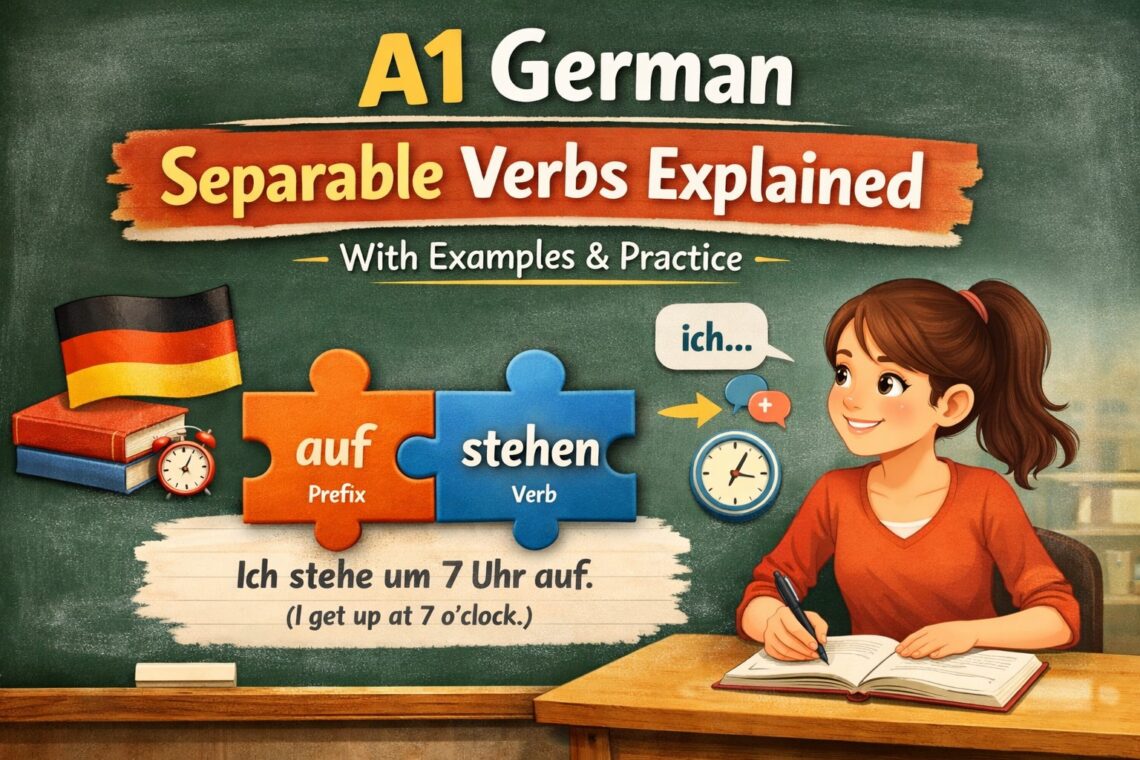
A1 German Separable Verbs Explained
If you’re learning German at A1 level, you will quickly notice something unusual:
some verbs seem to split into two parts.
This can feel confusing at first, especially when you see verbs like aufstehen or ankommen. The good news is that separable verbs follow clear rules, and once you understand them, they actually become very logical.
If you are just starting to learn German, it helps to understand the basics before focusing on grammar topics like separable verbs.
In this lesson, you’ll learn what separable verbs are, how to use them correctly at A1 level, and how to avoid common beginner mistakes.
What Are Separable Verbs in German?
A separable verb is a verb made of:
- a prefix (auf-, an-, mit-, ein-, etc.)
- a main verb
In certain sentences, the prefix separates from the verb and moves to the end of the sentence.
Example:
- aufstehen = to get up
Sentence:
Ich stehe um sieben Uhr auf.
(I get up at seven o’clock.)
📌 At A1 level, you will mainly use separable verbs in simple present tense sentences.
Why Separable Verbs Are Important at A1 Level
Many everyday German verbs are separable, especially when talking about:
- daily routines
- movement
- arriving and leaving
- starting or stopping activities
That’s why separable verbs appear very early in German learning — and also in A1 exams.
Separable verbs often appear in simple sentences that follow standard German word order.
Common A1 Separable Verbs You Should Know
Here are some of the most important separable verbs for beginners:
| Verb | Meaning |
|---|---|
| aufstehen | to get up |
| aufwachen | to wake up |
| ankommen | to arrive |
| einkaufen | to go shopping |
| fernsehen | to watch TV |
| mitkommen | to come along |
| ausgehen | to go out |
| anfangen | to start |
📌 You don’t need to memorise hundreds of verbs — start with the most common ones.
How Separable Verbs Work in Simple Sentences
In a main sentence, German word order looks like this:
Subject + verb (conjugated) + rest of sentence + prefix
Examples:
- Ich stehe um sechs Uhr auf.
- Wir kommen um acht Uhr an.
- Ich sehe am Abend fern.
📌 The prefix always goes to the end of the sentence.
Separable Verbs in Daily Routine Sentences (A1)
Separable verbs are extremely common when describing your day.
Examples:
- Am Morgen wache ich früh auf.
- Ich fange um neun Uhr an zu arbeiten.
- Am Abend sehe ich fern.
- Wir gehen am Wochenende aus.
These are perfect A1-level sentences — simple, clear, and natural.
Where Beginners Often Get Confused (Very Normal!)
❌ Common mistakes:
- Forgetting to separate the verb
- Putting the prefix in the wrong place
- Using the full verb at the end of the sentence
❌ Ich aufstehe um sieben Uhr.
✅ Ich stehe um sieben Uhr auf.
What Happens in Short Answers?
Sometimes German speakers use short answers, and the verb looks different.
Example:
Wann stehst du auf?
— Um sieben Uhr.
The verb is understood from context — this is normal and natural.
Practice Section
✍️ Exercise 1: Choose the Correct Sentence
Which sentence is correct?
a) Ich aufstehe um sechs Uhr.
b) Ich stehe um sechs Uhr auf.
✅ Correct answer: b)
✍️ Exercise 2: Complete the Sentence
Fill in the correct verb form:
- Ich _______ um sieben Uhr ___ (aufstehen).
- Wir _______ um acht Uhr ___ (ankommen).
Possible answers:
- Ich stehe um sieben Uhr auf.
- Wir kommen um acht Uhr an.
✍️ Exercise 3: Make Your Own Sentence
Write one sentence using:
- aufstehen
- fernsehen
Say the sentence out loud if possible.
Practising grammar regularly withA 1 German short tasks helps beginners master the German language with confidence.
How to Practice Separable Verbs Effectively
✔ Practice with daily routine sentences
✔ Say sentences out loud
✔ Focus on one verb at a time
✔ Don’t rush — repetition is key
At A1 level, understanding how the verb moves is more important than perfection.
Final Thoughts
Separable verbs may look strange at first, but they follow clear and logical rules. Once you get used to moving the prefix to the end of the sentence, they become much easier — and very useful in everyday German.
Take your time, practice with simple sentences, and don’t worry about mistakes. At A1 level, understanding comes step by step. As you progress, understanding verb structures will also help you prepare for the A 1 exams.


You May Also Like
How to Pass the A1 German Exam

How to Introduce Yourself in German
