German Cases Explained Simply (A1–A2 Beginners)
When learning German, many beginners notice something confusing very quickly:
articles and words seem to change, even though the meaning stays the same.
This happens because German uses cases.
If you’re new to grammar, don’t worry — at A1 level, you need to understand what German cases are and why they exist. This topic becomes much easier when you already understand A1 German basics.
What Are German Cases?
A case shows the role a person or thing plays in a sentence.
German cases help answer questions like:
- Who is doing something?
- Who or what is affected?
- Who receives something?
These roles become much clearer once you understand simple German sentence structure, because cases and word order work together.
Why Does German Use Cases?
English mainly shows meaning through word order.
German uses:
- Word order
- And changes in articles (cases)
This allows German to be more precise, even when word order changes.
📌 Your main goal is recognition.
The Three Most Important German Cases at A1
At beginner level, focus only on:
- Nominative
- Accusative
- Dative
- Genitive (comes later)
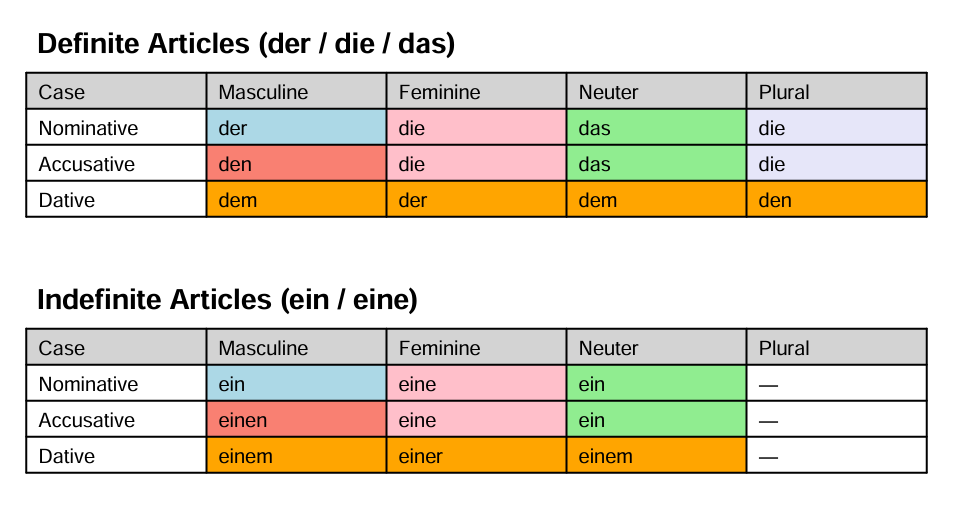
German Cases A 1 Cheat Sheet
1️⃣ Nominative Case – The Subject
The nominative case is used for the subject.
👉 The subject is who or what does the action.
Examples:
- Der Mann lernt Deutsch.
- Die Frau arbeitet hier.
- Ich lerne Deutsch.
📌 Tip:
The subject is usually at the beginning of the sentence.
2️⃣ Accusative Case – The Direct Object
The accusative case is used for the direct object.
👉 Ask: Who or what is affected by the action?
Examples:
- Der Mann sieht den Hund.
- Ich trinke einen Kaffee.
- Wir lernen Deutsch.
You may notice changes like:
- der → den
- ein → einen
These changes are part of learning how German articles der, die, das work in real sentences.
📌 Simply notice the change then you can memorise later.
3️⃣ Dative Case – The Indirect Object (A1 Introduction Only)
The dative case shows who receives something.
👉 Ask: To whom?
Examples:
- Der Mann gibt dem Kind Wasser.
- Ich helfe meiner Freundin.
At A1 level:
- You only need to recognise the dative
- Accuracy will come later
Many verbs naturally appear with the dative, which you’ll meet gradually when learning present tense German verbs.
German Cases in Real Sentences (A1 Examples)
Look at this example:
Der Mann gibt dem Hund den Ball.
- Der Mann → who acts (nominative)
- den Ball → what is given (accusative)
- dem Hund → who receives it (dative)
In a sentence with objects in both dative and accusative cases usualy the object in the dative case comes first before the object in the accusative case.
For Example in the above sentence dem Hund is the object in the dative case while den Ball is the object in the accusative case.
Understanding cases also helps you build clearer negative sentences, especially when learning negation in German (nicht vs kein).
Do I Need to Learn Case Tables at A1?
❌ No.
At A1 level, you should:
- Recognise cases
- Understand sentence roles
- Focus on communication
Full case tables, adjective endings, and complex rules belong to A2 and B1.
Language courses and exams defined by institutions such as the Goethe-Institut introduce cases slowly and step by step.
Common Beginner Difficulties (Totally Normal)
Many A1 learners:
- Mix up der / den / dem
- Feel unsure about article changes
- Avoid longer sentences
This is completely normal. With exposure and practice, patterns become familiar naturally.
How to Practice German Cases at A1
Beginner-friendly practice ideas:
- Highlight the subject in a sentence
- Ask “who?” and “what?”
- Read short texts and notice article changes
- Learn phrases instead of rules
Short, guided activities like these are part of effective A1 German practice exercises.
Summary: German Cases at A1
| Case | Role | A1 Goal |
|---|---|---|
| Nominative | Subject | Use confidently |
| Accusative | Direct object | Recognise & use often |
| Dative | Indirect object | Recognise only |
What Comes Next?
Once this introduction feels comfortable, learners usually continue with:
- Building longer sentences
- Asking questions
- Preparing for exams
German cases may seem difficult at first, but with time, they become logical and predictable.

How to Introduce Yourself in German

You May Also Like

How to Talk About Feelings and First Impressions in German (A2)

Negation in German