German Verb Conjugation Explained
German verb conjugation is one of the most important grammar topics at A1 level. The good news is that German verb forms follow clear and logical patterns, and once you understand them, forming sentences becomes much easier.
If you’re just starting out, it’s helpful to begin with a general overview of German before diving into grammar topics like verb conjugation. You may want to start with our A1 German basics guide, which explains how beginners should approach learning German step by step.
What Does “Verb Conjugation” Mean?
Verb conjugation means changing the verb form depending on:
- Who is doing the action (I, you, he, we…)
- The tense (present, past, etc.)
At A1 level, you only need to focus on:
👉 Present tense (Präsens)
Example in English:
- I work/ I am working- Ich arbeite
- He works/ He is working- Er arbeitet
German works in a similar way, but with clearer and more regular endings.
German Personal Pronouns (Quick Review)
Before learning how verbs change, you must know the subject pronouns:
| German | English |
|---|---|
| ich | I |
| du | you (informal) |
| er | he |
| sie | she |
| es | it |
| wir | we |
| ihr | you (plural) |
| Sie | you (formal) |
Understanding subject pronouns is essential before learning how verbs change. If you need a refresher, see our explanation of German personal pronouns at A1 level.
Regular German Verb Conjugation (A1 Core Rule)
Most German verbs follow a regular pattern in the present tense.
Step 1: Find the verb stem
Remove -en from the infinitive.
Examples:
- arbeiten (to work) → arbeit
- spielen (to play) → spiel
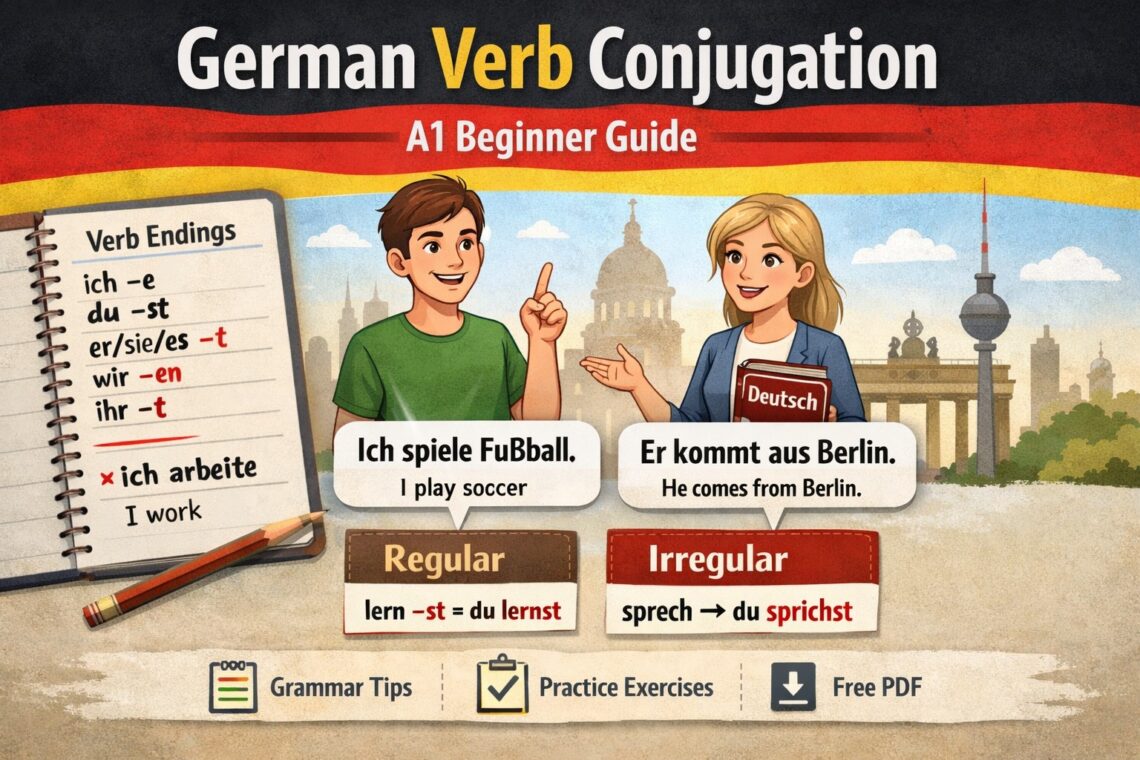
Step 2: Add the verb endings
| Pronoun | Ending | Example: arbeiten |
|---|---|---|
| ich | -e | ich arbeite |
| du | -st | du arbeitest |
| er / sie / es | -t | er arbeitet |
| wir | -en | wir arbeiten |
| ihr | -t | ihr arbeitet |
| Sie | -en | Sie arbeiten |
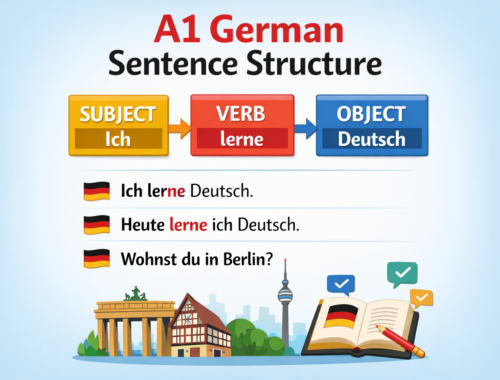
Verb endings only make sense when you also understand basic sentence order, so make sure you are familiar with simple German sentence structure.
Example: Verb “spielen” (to play)
| Pronoun | Sentence |
|---|---|
| ich | Ich spiele gern Tennis. |
| du | Du spielst heute Fußball. |
| er | Er spielt am Abend Gitarre. |
| wir | Wir spielen zusammen Karten. |
| Sie | Sie spielen sehr gut. |
When learning new verbs, always check their meaning and forms in a reliable dictionary such as the Online German Dictionary.
If you want to check the full conjugation of any German verb, you can also use a reliable German verb conjugation tool.
Common A1 Verbs You Should Learn First
Focus on verbs you will use every day:
| Verb | Meaning |
|---|---|
| sein | to be |
| haben | to have |
| arbeiten | to work |
| spielen | to play |
| kommen | to come |
| kaufen | to buy |
| essen | to eat |
| trinken | to drink |
These verbs appear frequently in beginner texts and exercises. You’ll find many of them organised in our guide to A1 German vocabulary by topic.
Irregular Verbs at A1 Level (Don’t Panic)
Some verbs change slightly in the du and er/sie/es forms.
Example: essen (to eat)
| Pronoun | Form |
|---|---|
| ich | esse |
| du | isst |
| er | isst |
| wir | essen |
Don’t worry if irregular verbs feel confusing at first — practice helps. You can reinforce these forms with A1 German practice exercises designed for beginners.
The Two Most Important Verbs: sein and haben
These verbs are irregular and extremely common.
sein (to be)
| Pronoun | Form |
|---|---|
| ich | bin |
| du | bist |
| er/sie/es | ist |
| wir | sind |
| ihr | seid |
| Sie | sind |
haben (to have)
| Pronoun | Form |
|---|---|
| ich | habe |
| du | hast |
| er/sie/es | hat |
| wir | haben |
| ihr | habt |
| Sie | haben |
📌 Memorise these forms early — they are essential for communication.
Practice Section (Very Important)
Try these exercises after reviewing the basics, or continue with more A1 German verb exercises with answers.
✍️ Exercise 1: Conjugate the verb kaufen (to buy)
- ich ______ Brot
- du ______ Obst
- wir ______ ein Geschenk
Answers:
- kaufe
- kaufst
- kaufen
✍️ Exercise 2: Choose the correct verb form
- Sie ___ jeden Tag Tee. (trinken)
- Er ___ in einem Büro. (arbeiten)
Answers:
- trinken
- arbeitet
Common Beginner Mistakes (Avoid These)
🚫 Forgetting to conjugate the verb
🚫 Using the infinitive instead of the verb form
🚫 Placing the verb at the end of main sentences
🚫 Mixing du and Sie endings
These mistakes are normal at A1 level — awareness helps you fix them quickly.
How to Practice German Verb Conjugation Effectively
✅ Say sentences out loud
✅ Write short daily sentences
✅ Practice with real-life examples
✅ Focus on present tense only
✅ Repeat common verbs regularly
Consistency matters more than speed.
Free Download
🎁 A1 German Verb Conjugation Cheat Sheet (PDF):
Final Thoughts
Verb conjugation is just one part of building a strong foundation in German. Once you understand the patterns and practice with real sentences, conjugating verbs becomes natural and intuitive.
To see how verb conjugation fits into your overall learning path, return to the A1 German beginner guide and continue building your skills step by step.

A1 German Daily Routine Vocabulary

Negation in German
You May Also Like

A1 German Listening Practice

A1 German Basics: How to Start Learning German.