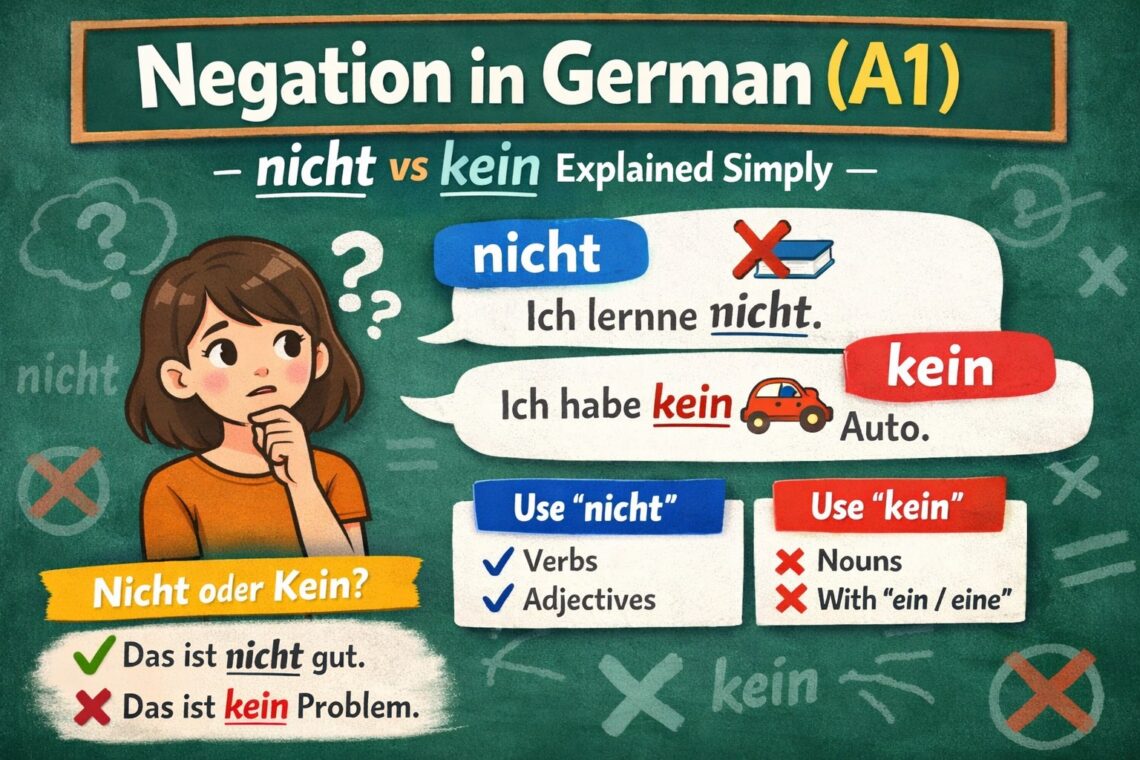
Negation in German
nicht vs kein Explained Simply
One of the first things learners want to do in German is say “no”, “not”, or “don’t”.
At A1 level, this is easier than it looks — German mainly uses two words for negation:
👉 nicht
👉 kein
If you’re just starting out, it’s important to understand how negation fits into basic sentence building. This topic makes much more sense once you are familiar with A1 German basics.
What Is Negation in German?
Negation means making a sentence negative.
Compare:
- Ich lerne Deutsch.
- Ich lerne Deutsch nicht.
German uses negation to:
- Say what you don’t do
- Express dislikes
- Correct information
- Communicate clearly in daily life
These roles become clearer once you understand simple German sentence structure, because negation is closely connected to word order.
1️⃣ Using nicht in German (A1)
When do we use nicht?
Use nicht to negate:
- Verbs
- Adjectives
- Adverbs
- Prepositional phrases
- Proper nouns
Examples:
- Ich arbeite heute nicht.
- Das ist nicht gut.
- Ich komme nicht aus Deutschland.
📌 Key idea:
Use nicht when you are not negating a noun with “ein / eine.”
Position of nicht (A1 Rule)
At A1 level, remember this simple rule:
nicht usually comes at the end of the sentence
Examples:
- Ich wohne hier nicht.
- Wir lernen Deutsch nicht.
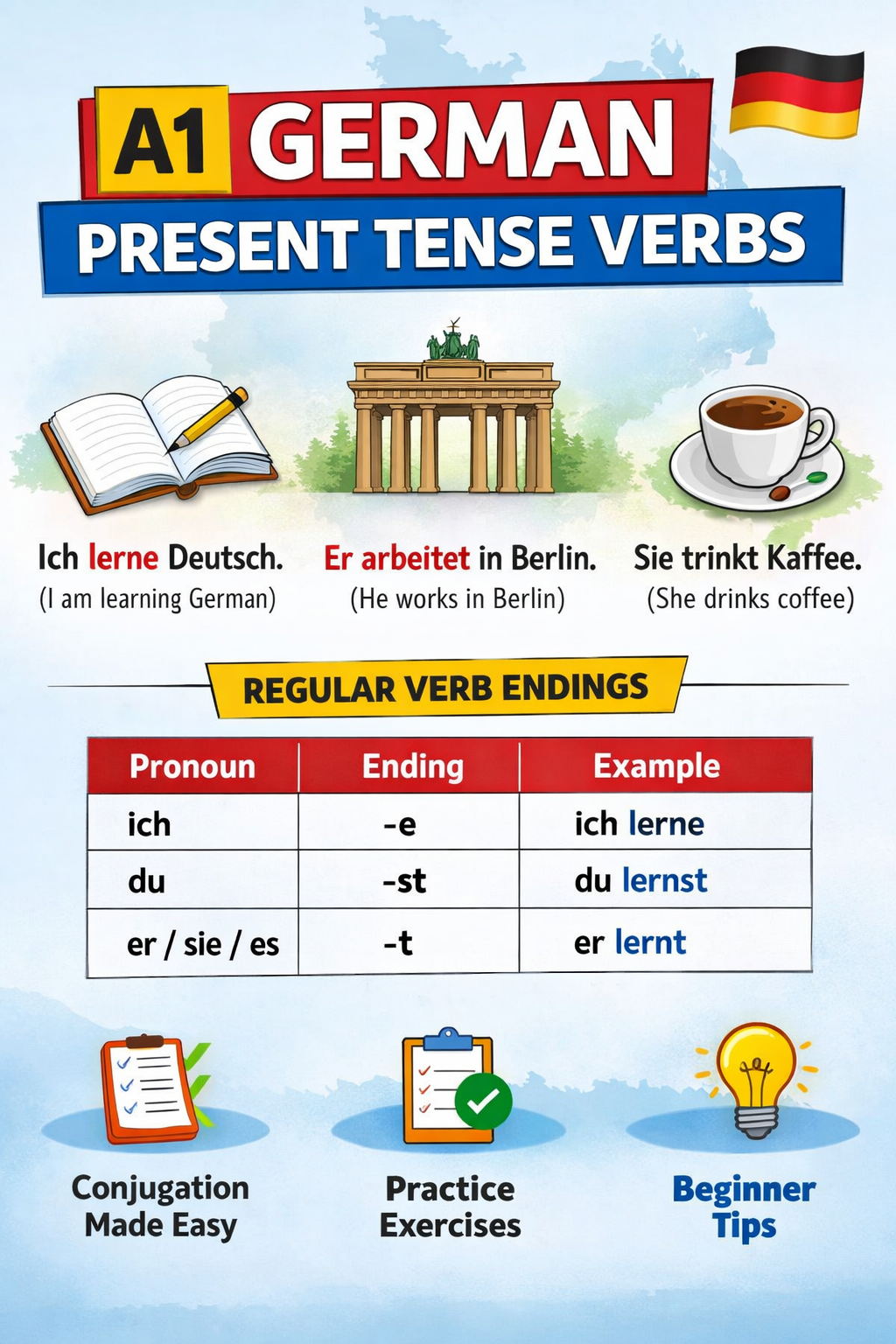
This position rule becomes clearer once you understand how present tense German verbs work in simple sentences.
2️⃣ Using kein in German (A1)
When do we use kein?
Use kein to negate:
- Nouns with ein / eine
- Nouns without an article
Examples:
- Ich habe kein Auto.
- Das ist kein Problem.
- Ich trinke keinen Kaffee.
📌 Key idea:
If you can replace the noun with ein / eine, you need kein.
This rule is closely connected to how German articles der, die, das work at A1 level.
How kein Changes (Simple Overview)
Just like ein, kein changes slightly:
- ein Mann → kein Mann
- eine Frau → keine Frau
- ein Kind → kein Kind
- Kinder → keine Kinder
Don’t worry about memorising forms yet — recognition is enough.
3️⃣ nicht or kein? (Quick Decision Rule)
Ask yourself this question:
👉 Am I negating a noun with “a / an”?
- YES → kein
- NO → nicht
Examples:
- Ich habe kein Buch.
- Ich lese das Buch nicht.
Many beginners struggle with this difference when learning their first sentences, which is completely normal for German for complete beginners.
Common Beginner Mistakes (Very Normal!)
❌ Ich habe nicht Auto.
✅ Ich habe kein Auto.
❌ Ich nicht lerne Deutsch.
✅ Ich lerne Deutsch nicht.
❌ Das ist kein gut.
✅ Das ist nicht gut.
Mistakes like these disappear naturally with practice.
Practice Exercises (A1 Level)
✍️ Exercise 1: Choose nicht or kein
- Ich habe ___ Zeit.
- Das ist ___ richtig.
- Ich trinke ___ Kaffee.
- Wir lernen Deutsch ___.
Answers:
- keine
- nicht
- keinen
- nicht
✍️ Exercise 2: Make the sentences negative
- Ich wohne in Berlin.
- Ich habe ein Auto.
- Das ist gut.
Possible answers:
- Ich wohne in Berlin nicht.
- Ich habe kein Auto.
- Das ist nicht gut.
Practising grammar regularly with short tasks like these is part of effective A1 German practice exercises.
Why Negation Is Important at A1
Negation helps you:
- Express opinions
- Say what you don’t like
- Correct misunderstandings
- Communicate more naturally
This is why negation is a core A1 grammar topic in courses and exams defined by institutions such as the Goethe-Institut.
Understanding negation also helps you place words correctly when building sentences, especially as grammar becomes more complex.
Summary: nicht vs kein
| Use | Negation |
|---|---|
| Verbs, adjectives, places | nicht |
| Nouns with ein / eine | kein |
📌 At A1 level, focus on:
- Choosing the right word
- Keeping sentences simple
- Communicating clearly
What Comes Next?
Once negation feels comfortable, learners usually continue with:
- More sentence building
- Asking questions
- Preparing for exams
Understanding how negation works will make these steps much easier.


You May Also Like

A1 German Vocabulary Topics

A1 German Pronunciation Guide (Alphabet, Sounds & Common Mistakes)
