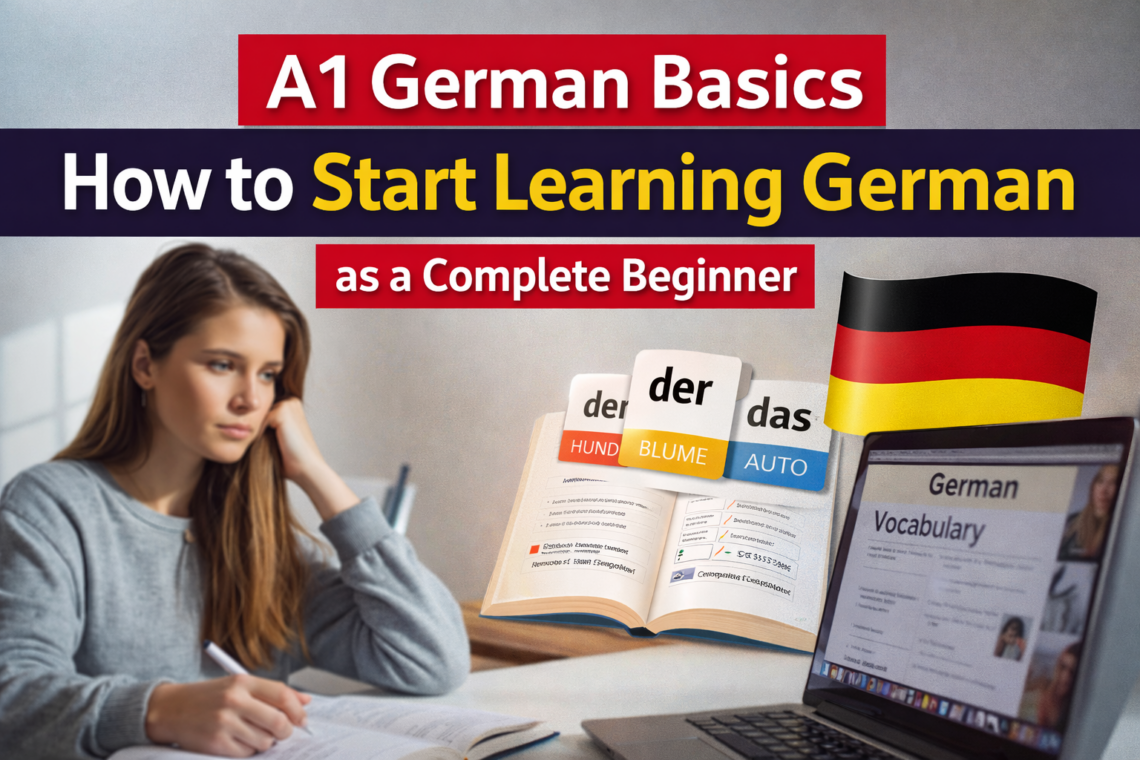
A1 German Basics: How to Start Learning German.
Learning German as a complete beginner can feel overwhelming at first — new sounds, unfamiliar grammar, and long words. The good news is that German at A1 level is very structured and logical, and with the right approach, you can start communicating surprisingly quickly.
This guide will show you exactly how to start learning German from zero, what to focus on at A1 level, and how to build a strong foundation without confusion.
What Does “A1 German” Mean?
A1 is the first level of the Common European Framework of Reference for Languages (CEFR). At this level, you learn how to:
- Introduce yourself
- Ask and answer simple questions
- Understand basic everyday phrases
- Talk about familiar topics like family, work, food, and hobbies
If you’re completely new to German, this guide will give you a clear foundation before moving on to topics like pronunciation, grammar, and exam preparation.
A1 German focuses on communication, not perfection.
Institutions such as the Goethe-Institut define A1 as the level where learners can use simple language to meet basic needs.
Step 1: Learn the German Alphabet & Pronunciation
German uses the Latin alphabet, just like English, but pronunciation is different.
Special German Letters You Must Know
| Letter | How it sounds | Example |
|---|---|---|
| ä | like “e” in bed | Mädchen |
| ö | similar to “ir” in “Shirt” | schön |
| ü | say “ee” with rounded lips. Similar to “Eu” in “Europe” | über |
| ß | sharp “s” similar to “s” in “Slap” | Straße |
📌 Tip: German pronunciation is mostly consistent — words are usually pronounced the way they are written.
Practice
Say these words out loud:
- fünf
- schön
- über
- Straße
Repeat each word three times.
For a deeper explanation of sounds, umlauts, and pronunciation rules, see our detailed A1 German pronunciation guide.
Step 2: Learn Essential German Phrases First
Before grammar rules, you need survival phrases.
Basic German Phrases for Beginners
| German | English |
|---|---|
| Hallo | Hello |
| Guten Morgen | Good morning |
| Wie heißt du? | What is your name? |
| Ich heiße … | My name is … |
| Danke | Thank you |
| Bitte | Please / You’re welcome |
These expressions are part of a larger list of everyday expressions you’ll use at A1 level.
📌 These phrases allow you to start interacting immediately, even with limited vocabulary.
Step 3: Understand Simple German Sentence Structure
German sentences at A1 are clear and predictable.
Basic Sentence Pattern
Subject + Verb + Object
Sentence structure is one of the most important topics at A1 level, especially verb position.
Examples:
- Ich lerne Deutsch. (I learn German.)
- Ich wohne in Berlin. (I live in Berlin.)
- Ich mag Kaffee. (I like coffee.)
📌 The verb usually comes in position 2 — this is very important in German.
Step 4: Learn the Most Important A1 Grammar Topics
You do not need advanced grammar at A1. Focus on these basics:
Core Grammar Topics
- Personal pronouns (ich, du, er, sie, wir)
- Present tense verbs (lernen, wohnen, heißen)
- Articles (der, die, das, ein, eine)
- Simple questions (Was? Wo? Wie?)
- Negation (nicht, kein)
📌 Mastering these basics gives you huge confidence early on.
Step 5: Build A1 Vocabulary in Context
Instead of memorising long word lists, learn words in themes.
Important A1 Vocabulary Topics
- Family (Mutter, Vater, Freund)
- Food & drinks (Brot, Wasser, Kaffee)
- Numbers & time
- Daily routines
- Places (Haus, Schule, Arbeit)
- Health and sickness
- Shopping Vocabulary
- Offices and customer care
To build confidence faster, focus on learning vocabulary in topics instead of isolated word lists.
Example in Context
Ich trinke Kaffee am Morgen.
(I drink coffee in the morning.)
This is far more effective than learning words alone.
Step 6: Start Listening to German Early
Even if you don’t understand everything, listening trains your ear.
Good A1 listening activities include:
- Slow beginner dialogues
- Simple German videos with subtitles
- Repeating short sentences aloud
📌 You don’t need to understand every word — focus on recognising sounds and rhythm.
Step 7: Speak German from Day One
Many beginners are afraid to speak. Don’t wait.
Simple Speaking Practice
- Introduce yourself aloud
- Describe your day in simple sentences
- Talk to yourself while doing daily tasks
Example:
Ich heiße Anna.
Ich lerne Deutsch.
Ich wohne in Nairobi.
Speaking early builds confidence and fluency.
Practice Section
✍️ Exercise 1: Translate into German
- My name is Maria.
- I live in Germany.
- I like tea.
Possible answers
- Ich heiße Maria.
- Ich wohne in Deutschland.
- Ich mag Tee.
✍️ Exercise 2: Build Sentences
Use these words:
- ich / gehen / in den Park.
- ich / machen / Sport
Try to write full sentences.
If you want more guided practice, start with Grammar exercises designed specifically for beginners.
Common Mistakes A1 Beginners Should Avoid
🚫 Trying to learn too much grammar at once
🚫 Translating every word mentally
🚫 Waiting too long to speak
🚫 Comparing yourself to advanced learners
📌 Progress at A1 comes from consistency, not speed.
Suggested A1 Study Plan (Simple & Realistic)
Daily (30–45 minutes):
- 10 min vocabulary
- 10 min grammar
- 10 min listening
- 5–10 min speaking
Consistency beats long, irregular study sessions.
Final Thoughts
Learning German as a complete beginner doesn’t have to be stressful. At A1 level, your goal is simple communication, not perfect grammar. With regular practice, clear structure, and patience, you’ll be surprised how quickly you progress.
If you stay consistent and focus on the basics, German will start to make sense very soon.
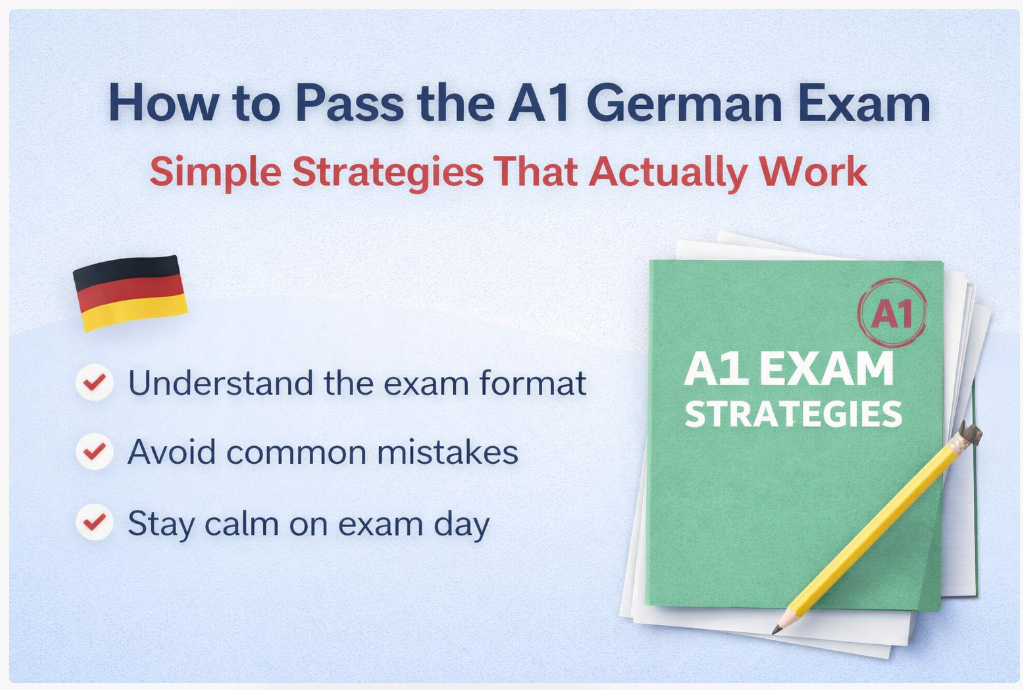
Once you feel comfortable with A1 basics, the next step for many learners is preparing for an official exam

3 Comments
Violah Akai
👍
Lavenda misiko
Was interested to learn german
Frau Kolb
This is a safe place to start. Click on the words in blue they will always guide to the next lesson or Youtube lessons.