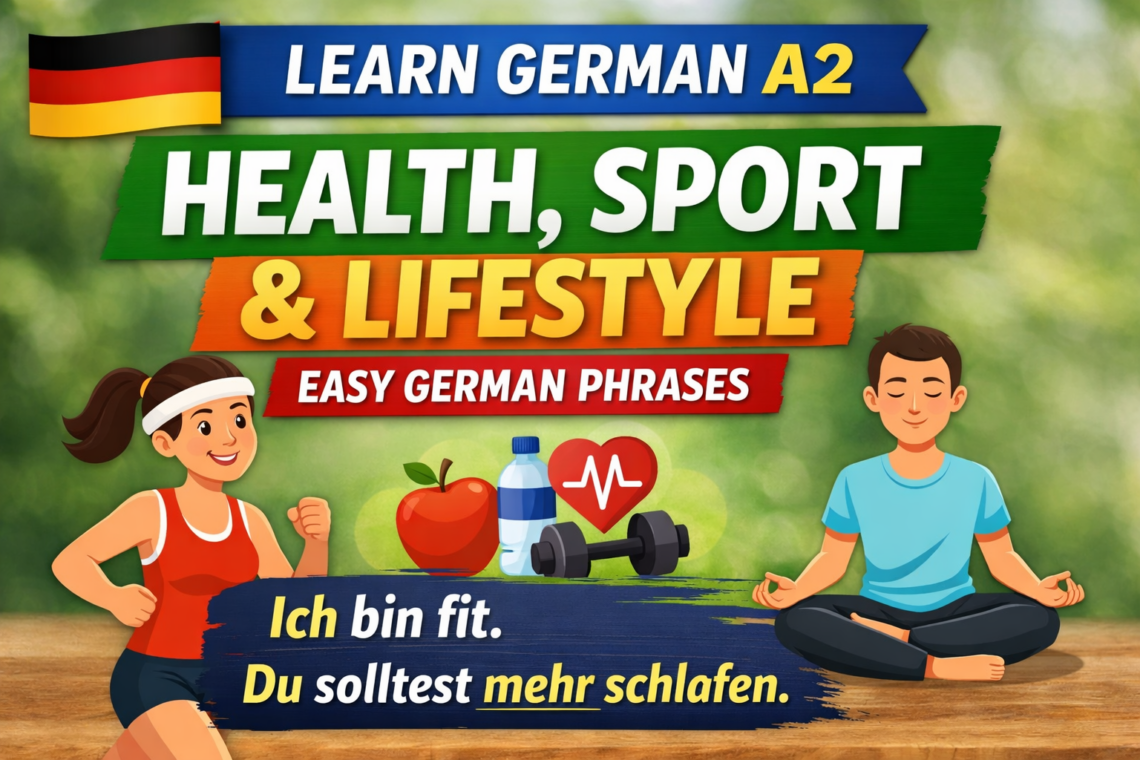
Talking About Health, Sport and Lifestyle in German (A2)
At A2 level in German, learners begin to talk not only about daily routines, but also about health, sport, and lifestyle.
This topic is important because it helps learners:
- describe habits and routines
- talk about free time activities
- understand simple advice
- communicate in everyday situations
In this guide, you will learn how to talk about health, sport, and lifestyle in German at A2 level, using simple structures and practical examples.
1. Talking About Sports in German (A2)
At A2 level, sport is usually described with:
- machen (to do)
- spielen (to play)
- gehen (to go)
Common A2 Sports Vocabulary
| German | English |
|---|---|
| Sport machen | to do sport |
| Fußball spielen | to play football |
| schwimmen | to swim |
| laufen | to run |
| ins Fitnessstudio gehen | to go to the gym |
Examples with Different Pronouns
- Ich mache gern Sport.
- Du spielst Fußball.
- Er läuft jeden Tag.
- Sie geht ins Fitnessstudio.
- Wir machen oft Sport.
- Man sollte regelmäßig Sport machen.
2. Talking About Health in German
To describe health, learners use sein (to be) and sich fühlen (to feel).
Useful Vocabulary
| German | English |
|---|---|
| gesund | healthy |
| krank | sick |
| müde | tired |
| fit | fit |
| sich fühlen | to feel |
Examples
- Ich bin gesund.
- Du bist müde.
- Er ist krank.
- Sie fühlt sich gut.
- Wir sind fit.
You can also describe general ideas:
- Man ist gesund, wenn man Sport macht.
👉 To review how to describe feelings in more detail, see our guide on
talking about feelings and first impressions in German (A2).
3. Talking About Lifestyle and Daily Habits
Lifestyle includes daily habits such as eating, drinking, and sleeping.
Important Vocabulary
| German | English |
|---|---|
| essen | to eat |
| trinken | to drink |
| schlafen | to sleep |
| gesund leben | to live healthily |
Examples with Pronouns
- Ich esse gesund.
- Du trinkst viel Wasser.
- Er schläft acht Stunden.
- Wir leben gesund.
You can also use man for general statements:
- Man sollte viel Wasser trinken.
- Man sollte genug schlafen.
👉 You can also explore this topic further in
talking about food and eating habits in German (A2).
4. Expressing Likes and Preferences (A2)
To talk about preferences, A2 learners use:
- gern / gerne
- mögen
Examples
- Ich mache gern Sport.
- Du gehst gern schwimmen.
- Er mag Fußball.
- Wir mögen Sport.
These structures are essential for A2 speaking exams.
5. Giving Simple Health Advice in German (A2)
At A2 level, advice is simple and direct.
Useful Structures
- Du solltest … (You should …)
- Man sollte … (One should …)
- Du kannst … (You can …)
Examples
- Du solltest mehr Wasser trinken.
- Man sollte genug schlafen.
- Du kannst mehr Sport machen.
👉 For a deeper explanation, see
giving advice in German with “sollte” (A2).
6. Talking About Habits (A2)
Frequency words help describe routines:
- oft (often)
- manchmal (sometimes)
- selten (rarely)
- immer (always)
Examples
- Ich mache oft Sport.
- Du isst manchmal Fast Food.
- Er schläft immer genug.
- Wir trinken oft Wasser.
These expressions are very useful in everyday conversations.
7. Mini Dialogue (A2 Level)
A: Machst du Sport?
B: Ja, ich gehe oft schwimmen.
A: Bist du fit?
B: Ja, ich fühle mich gut.
8. Practice: Try It Yourself (A2)
Exercise 1: Complete the Sentences
- Du solltest mehr ______ trinken.
- Ich mache ______ Sport.
- Man sollte genug ______.
Exercise 2: Write About Lifestyle
Answer in simple sentences:
- Machst du Sport?
- Was isst du gern?
- Was sollte man machen, um gesund zu bleiben?
Example:
Ich mache oft Sport.
Ich esse gern Obst.
Man sollte viel Wasser trinken.
Exercise 3: Speaking Practice
Practice aloud:
- Ich mache gern …
- Du solltest …
- Man sollte …
9. Summary: What You Should Remember (A2)
At A2 level, learners should be able to:
- talk about sport and free time
- describe health
- explain daily habits
- give simple advice
🔗 Related A2 Topics
To continue learning, explore:
- talking about feelings and first impressions in German (A2)
- talking about food and eating habits in German (A2)
- giving advice in German with “sollte” (A2)
These topics are closely connected and help build strong A2 communication skills.
Learn German Step by Step
If you want structured A2 German lessons with:
- video explanations
- vocabulary lists
- exercises and quizzes
- speaking and writing practice
you can explore the full A2 German course, designed to help learners build confidence step by step.


You May Also Like
A1 German Present Tense Verbs Explained

How to Introduce Yourself in German
