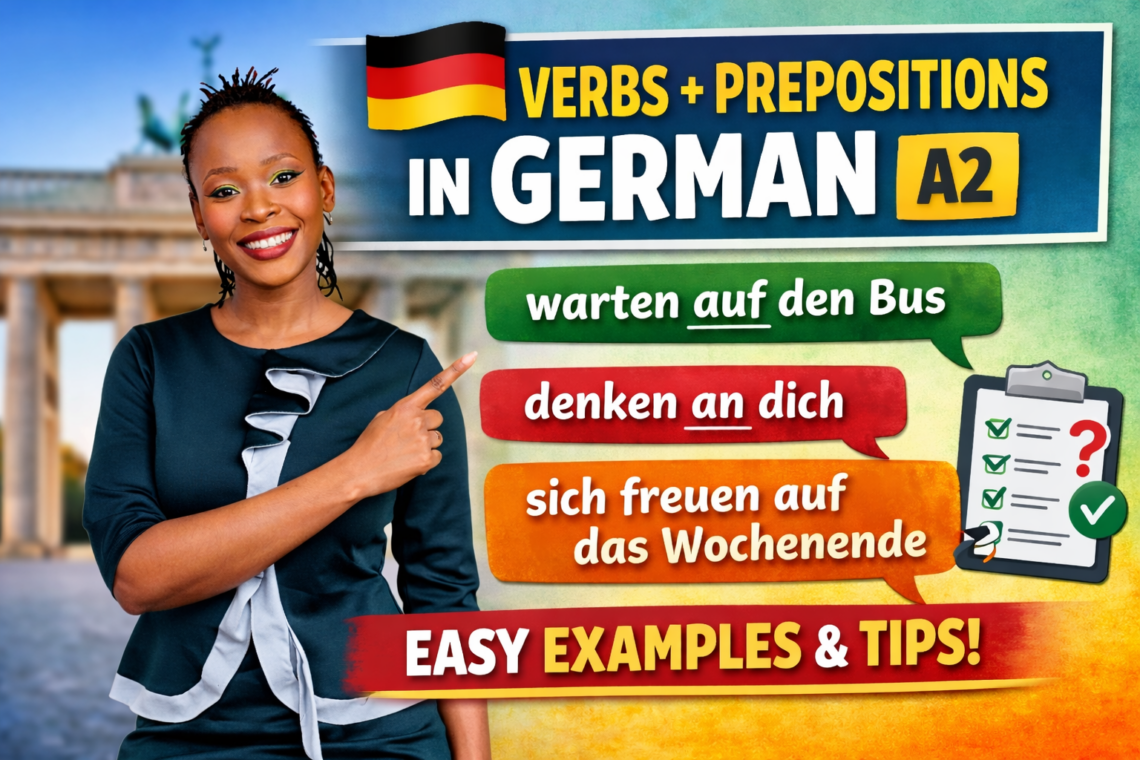
Verbs with Prepositions in German (A2): Simple Explanation and Examples
At A2 level in German, you already know many basic verbs like gehen, machen, or lernen.
But then you see sentences like:
- Ich warte auf den Bus.
- Sie interessiert sich für Musik.
And suddenly, German feels more difficult.
This happens because some verbs in German always need a preposition.
In this post, you will learn how verbs with prepositions work at A2 level, how to use them in real situations, and how to avoid common mistakes.
1. What Are Verbs with Prepositions?
Some German verbs are always used together with a fixed preposition.
Example:
- ❌ Ich warte den Bus.
- ✅ Ich warte auf den Bus.
You must learn them as a pair:
warten auf
Other examples:
- denken an
- sprechen über
- sich freuen auf
📌 At A2 level, the best strategy is:
👉 Learn the verb + preposition together, not separately.
2. Common Verbs with Prepositions (A2 List)
Here are some of the most important verbs you need at A2 level.
| Verb + Preposition | Meaning | Example |
|---|---|---|
| warten auf | to wait for | Ich warte auf den Bus. |
| denken an | to think about | Er denkt an seine Familie. |
| sprechen über | to talk about | Wir sprechen über den Kurs. |
| sich freuen auf | to look forward to | Sie freut sich auf das Wochenende. |
| sich interessieren für | to be interested in | Du interessierst dich für Deutsch. |
| fragen nach | to ask about | Ich frage nach dem Weg. |
3. Using Different Personal Pronouns
At A2 level, it is very important to practice with different subjects, not only ich.
Examples with Different Pronouns
- Ich warte auf den Bus.
- Du wartest auf den Zug.
- Er denkt an seine Arbeit.
- Sie interessiert sich für Musik.
- Wir sprechen über den Kurs.
- Ihr freut euch auf das Wochenende.
- Sie (plural) warten auf den Lehrer.
📌 This is very useful for:
- speaking exams
- real conversations
👉 You can practice using these in everyday situations in our guide on
talking about daily life and routines in German (A2).
4. Which Case Comes After the Preposition?
Each preposition uses a specific case.
At A2 level, you should notice patterns, not memorise everything at once.
Examples
Akkusativ:
- warten auf den Bus
- denken an die Arbeit
Dativ:
- sprechen mit dem Lehrer
- fragen nach dem Preis
📌 Tip:
👉 Always learn:
verb + preposition + example sentence
This is much easier than learning rules alone.
5. Reflexive Verbs with Prepositions (A2)
Some verbs are also reflexive, which means they need a reflexive pronoun.
Examples
- Ich freue mich auf den Urlaub.
- Du freust dich auf das Wochenende.
- Er freut sich auf den Kurs.
- Wir freuen uns auf die Reise.
Another example:
- Sie interessiert sich für Deutsch.
- Ihr interessiert euch für Sport.
📌 Structure:
Subject + reflexive pronoun + verb + preposition
6. Using These Verbs in Real Situations
These verbs are very common in everyday A2 communication.
Examples:
- Ich warte auf den Bus.
- Wir sprechen über unsere Arbeit.
- Sie freut sich auf den Urlaub.
- Du interessierst dich für Deutsch.
👉 You will use these expressions when:
- talking about your experiences
- describing your daily life
- speaking about plans
You can also combine them with feelings, for example in
talking about first impressions and feelings in German (A2).
7. Common Mistakes (A2 Learners)
❌ Wrong preposition
Ich warte für den Bus.
✅ Correct:
Ich warte auf den Bus.
❌ Missing reflexive pronoun
Ich freue auf das Wochenende.
✅ Correct:
Ich freue mich auf das Wochenende.
❌ Mixing structures
Ich interessiere für Deutsch.
✅ Correct:
Ich interessiere mich für Deutsch.
📌 These mistakes are very normal — practice will fix them.
8. Practice: Try It Yourself (A2)
Exercise 1: Choose the Correct Preposition
- Ich warte ___ den Bus.
- Du interessierst dich ___ Musik.
- Wir sprechen ___ den Kurs.
Exercise 2: Complete with the Correct Pronoun
- Ich freue ___ auf das Wochenende.
- Wir freuen ___ auf den Urlaub.
- Sie interessiert ___ für Deutsch.
Exercise 3: Write Your Own Sentences
Answer these questions:
- Worauf wartest du heute?
- Worüber sprichst du oft?
- Wofür interessierst du dich?
Example:
Ich warte auf den Bus.
Ich spreche über meinen Kurs.
Ich interessiere mich für Sprachen.
9. Summary: What You Should Remember (A2)
At A2 level:
- Some verbs always need a fixed preposition
- Learn them as a complete unit
- Many are reflexive
- Practice with different personal pronouns
Simple, correct sentences are more important than complicated grammar.
Learn German Step by Step
If you want structured A2 German lessons with:
- clear video explanations
- vocabulary lists
- workbooks and quizzes
- speaking and writing practice
you can explore my full A2 German course, designed to help you speak with confidence.


You May Also Like

A1 German Listening Practice
Wechselpräpositionen Explained Simply (A2 German)
