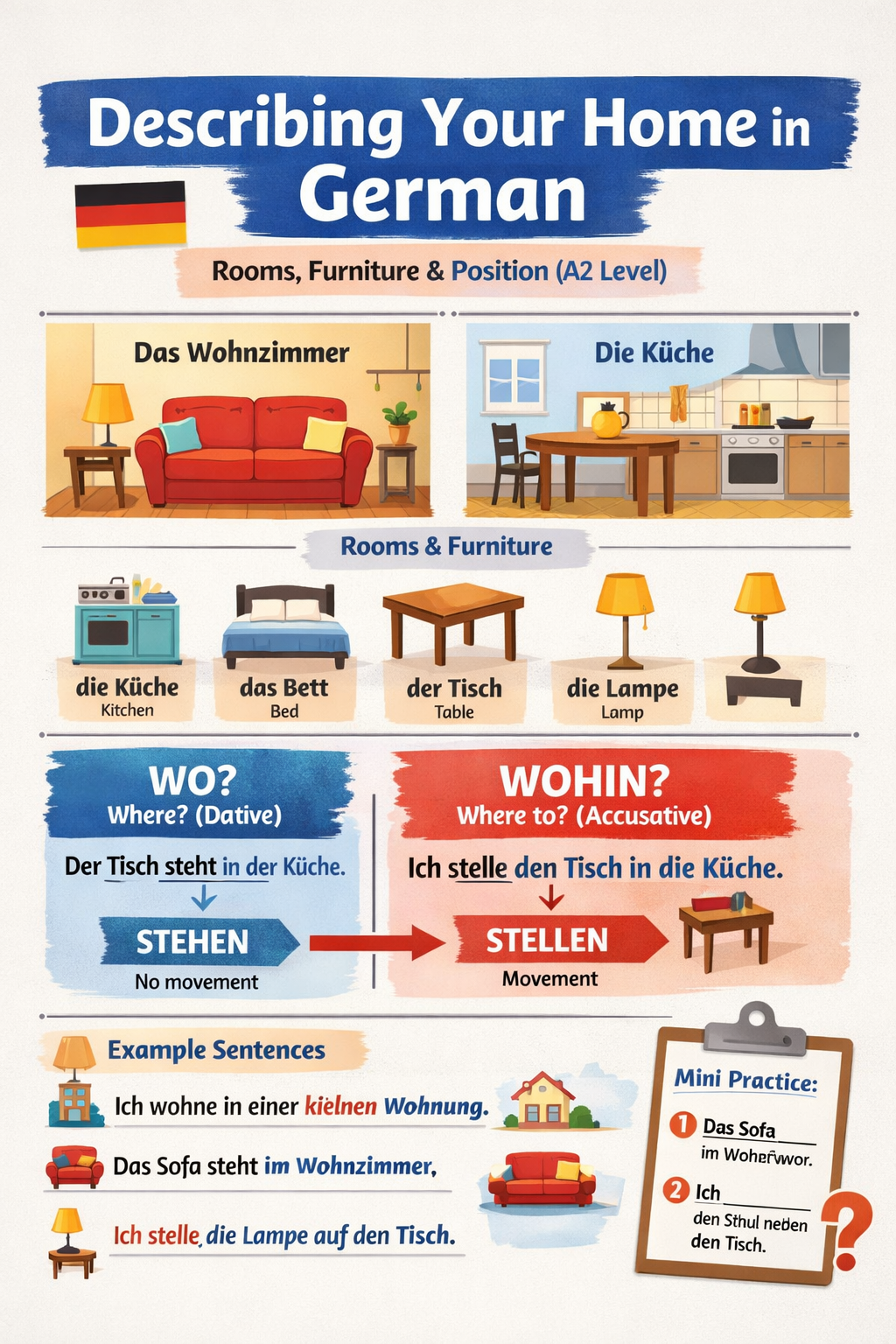
Describing Your Home in German (A2): Rooms, Furniture and Position
Talking about your home is a very common topic when learning German.
You may want to describe:
- where you live
- which rooms you have
- where furniture is
In everyday German conversations, people often talk about their homes, apartments, or rooms.
In this lesson, you will learn how to:
- describe rooms and furniture
- say where things are
- understand the difference between wo and wohin
- use verbs like stehen, stellen, liegen, legen
- use simple adjective phrases such as in einer kleinen Wohnung
All examples are simple and useful for A2 learners.
1. Rooms in the House
Let’s start with some important room vocabulary.
| German | English |
|---|---|
| das Wohnzimmer | living room |
| das Schlafzimmer | bedroom |
| die Küche | kitchen |
| das Badezimmer | bathroom |
| der Flur | hallway |
| der Balkon | balcony |
Example sentences
Ich habe ein Wohnzimmer.
Die Küche ist groß.
Mein Schlafzimmer ist ruhig.
These sentences are simple and perfect for A2.
2. Furniture Vocabulary
Now let’s learn some common furniture words.
| German | English |
|---|---|
| der Tisch | table |
| der Stuhl | chair |
| das Sofa | sofa |
| das Bett | bed |
| der Schrank | wardrobe |
| die Lampe | lamp |
Examples
Im Wohnzimmer steht ein Sofa.
In der Küche gibt es einen Tisch.
Das Bett steht im Schlafzimmer.
3. Saying Where Things Are: Wo?
When we talk about position, we ask the question:
Wo? (Where?)
German uses dative case after many prepositions.
👉 If you want a full explanation, read our guide on
Wechselpräpositionen in German (A2).
Common prepositions
| German | English |
|---|---|
| in | in |
| auf | on |
| unter | under |
| neben | next to |
| an | on / at |
Examples
Der Tisch steht in der Küche.
Das Sofa steht im Wohnzimmer.
Die Lampe steht auf dem Tisch.
4. Wo oder Wohin?
German distinguishes between position and movement.
| Question | Meaning | Case |
|---|---|---|
| Wo? | Where? | Dativ |
| Wohin? | Where to? | Akkusativ |
Examples
Wo steht der Tisch?
→ Der Tisch steht in der Küche.
Wohin stellst du den Tisch?
→ Ich stelle den Tisch in die Küche.
5. Stehen oder Stellen?
Many learners are unsure when to use stehen or stellen.
Stehen (no movement)
Use stehen when something is already in a place.
Examples:
Der Tisch steht in der Küche.
Das Sofa steht im Wohnzimmer.
Die Lampe steht auf dem Tisch.
Stellen (movement)
Use stellen when someone moves an object.
Examples:
Ich stelle den Tisch in die Küche.
Sie stellt die Lampe auf den Tisch.
Wir stellen das Sofa ins Wohnzimmer.
Quick rule
| Situation | Verb |
|---|---|
| no movement | stehen |
| movement | stellen |
Ask yourself:
Does something move?
If yes → stellen
If no → stehen
6. Verbs with Wechselpräpositionen
Some verbs appear in pairs.
One verb describes position.
The other describes movement.
👉 You can explore this topic further in our post on
verbs with Wechselpräpositionen (A2 German).
| Position (Wo + Dativ) | Movement (Wohin + Akkusativ) |
|---|---|
| liegen | legen |
| stehen | stellen |
| stecken | stecken |
| hängen | hängen |
liegen / legen
Das Buch liegt auf dem Tisch.
Ich lege das Buch auf den Tisch.
stehen / stellen
Der Tisch steht im Wohnzimmer.
Ich stelle den Tisch ins Wohnzimmer.
hängen
Das Bild hängt an der Wand.
Ich hänge das Bild an die Wand.
stecken
Der Schlüssel steckt in der Tasche.
Ich stecke den Schlüssel in die Tasche.
7. Directional Adverbs
German also uses special words to show direction.
Wo? (Position)
| German | Meaning |
|---|---|
| hier | here |
| da | there |
| dort | there |
Example:
Das Sofa steht hier.
Wohin? (Direction)
| German | Meaning |
|---|---|
| hierhin | to here |
| dahin | to there |
| dorthin | to there |
Example:
Komm hierhin.
Other common direction words
| German | Meaning |
|---|---|
| rein | in |
| raus | out |
| rauf | up |
| runter | down |
| rüber | across |
Examples:
Komm rein.
Ich gehe raus.
Der Ball fällt runter.
8. Adjective Example
German adjectives come before nouns and change their endings.
Example:
Ich wohne in einer kleinen Wohnung.
👉 If you want a clear explanation, read our post on
German adjective endings (A2 made simple).
Here:
Wohnung = feminine noun
in = dative preposition
kleine → kleinen
So we say:
in einer kleinen Wohnung
9. Example Description of a Home
Here is a simple description:
Ich wohne in einer kleinen Wohnung.
Es gibt ein Wohnzimmer und eine Küche.
Das Sofa steht im Wohnzimmer.
Der Tisch steht neben dem Sofa.
Die Küche ist klein, aber hell.
This is a perfect A2 description.
10. Practice
Complete the sentences.
- Das Sofa ______ im Wohnzimmer.
- Ich ______ den Tisch in die Küche.
- Das Buch ______ auf dem Tisch.
- Ich ______ das Buch auf den Tisch.
Answers
steht
stelle
liegt
lege
11. Speaking Practice
Describe your home.
Answer these questions:
- Wo wohnst du?
- Welche Zimmer hast du?
- Wo steht ein Möbelstück?
Example:
Ich wohne in einer kleinen Wohnung.
Das Sofa steht im Wohnzimmer.
Der Tisch steht neben dem Sofa.
Summary
You can now:
- name rooms and furniture
- describe where things are
- use wo and wohin
- understand stehen vs stellen
- use verbs like liegen / legen
- describe your home in simple German
These structures are very useful for A2 speaking and writing.
Learn German Step by Step
If you want structured A2 German lessons with:
- videos
- vocabulary lists
- exercises and worksheets
- speaking practice
👉 Explore the full A2 German course with lessons, videos and exercises.


You May Also Like
Weil vs Denn in German (A2): How to Give Reasons Simply

B1 German: How to Use „seit“, „seitdem“ and „bis“ (Explained with Examples & Story)
