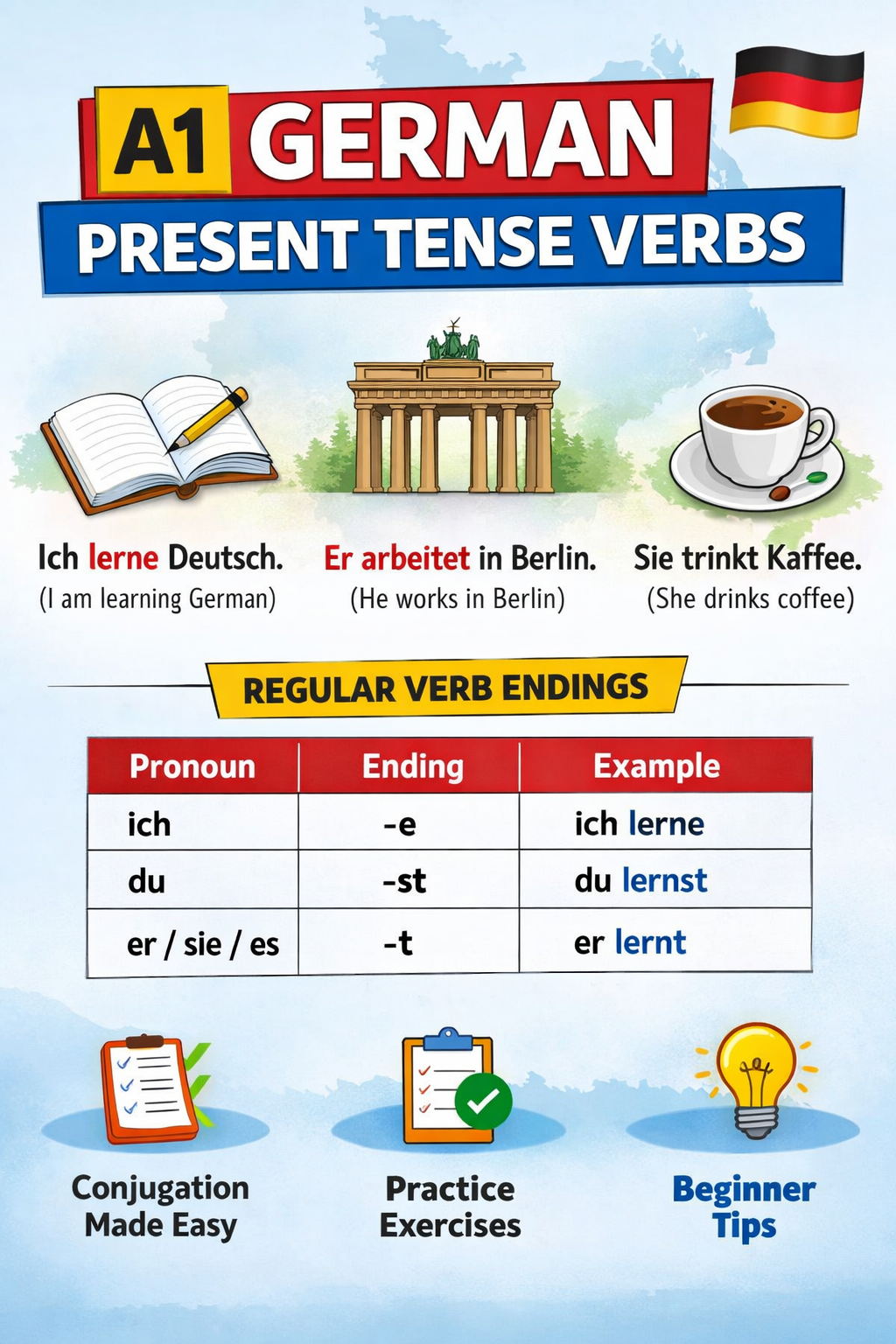
A1 German Present Tense Verbs Explained
German present tense verbs (Präsens) are one of the most important grammar topics at A1 level. They allow you to talk about what you do every day, where you live, what you like, and what you are learning right now.
If you’re just starting to learn German, it’s helpful to first understand the basics of sentence structure and how verbs fit into simple beginner sentences.
In this guide, you’ll learn how German present tense verbs work, how to conjugate them, and how to use them correctly in simple sentences.
What Is the German Present Tense?
The German present tense (Präsens) is used to talk about:
- Things happening now
- Things you do regularly
- General facts
Examples:
- Ich lerne Deutsch. (I am learning German.)
- Ich arbeite in Berlin. (I work in Berlin.)
- Ich trinke Kaffee. (I drink coffee.)
📌 German does not have a separate continuous tense like English (“I am doing”). One form covers both meanings.
Regular German Verbs in the Present Tense (A1)
At A1 level, you focus mainly on regular verbs.
Step 1: Find the verb stem
Remove -en from the infinitive.
| Infinitive | Stem |
|---|---|
| lernen (to learn) | lern- |
| arbeiten (to work) | arbeit- |
| wohnen (to live) | wohn- |
Step 2: Add present tense endings
| Pronoun | Ending | Example (lernen) |
|---|---|---|
| ich | -e | ich lerne |
| du | -st | du lernst |
| er / sie / es | -t | er lernt |
| wir | -en | wir lernen |
| ihr | -t | ihr lernt |
| sie / Sie | -en | sie lernen |
Conjugation means changing the verb ending to match the subject, and this is a key skill you need to master at A1 level.
Example Sentences
- Ich lerne Deutsch.
- Du arbeitest in einer Schule.
- Wir wohnen in Deutschland.
Verb Position in German Sentences (VERY IMPORTANT)
In simple main clauses, the verb is always in position 2.
Verb position is one of the most important rules at A1 level and applies to all simple main clauses. German sentence structure at A1 level
Examples:
- Ich gehe in die Schule.
- Heute mache ich Sport.
- In Berlin wohnen viele Leute.
📌 Even when the sentence starts with time or place, the verb stays in position 2.
Common A1 Verbs You Should Learn First
Here are some essential A1 German verbs:
| Verb | Meaning |
|---|---|
| lernen | to learn |
| wohnen | to live |
| arbeiten | to work |
| kommen | to come |
| gehen | to go |
| machen | to make/do |
| trinken | to drink |
| essen | to eat |
| sprechen | to speak |
| hören | to hear |
Learning verbs together with related A1 German vocabulary by Topic helps you form meaningful sentences faster.
Using Verbs in Simple Daily Sentences
At A1 level, keep sentences short and clear.
Examples:
- Ich trinke Saft.
- Ich esse Pizza.
- Ich spreche Deutsch.
- Wir lernen zusammen.
These types of sentences are often used when talking about everyday routines in German
📌 Short sentences are correct and natural at this level.
Yes/No Questions in the Present Tense
To ask a yes/no question, put the verb first.
Examples:
- Lernst du Deutsch?
- Arbeitest du heute?
- Wohnst du in Nairobi?
Asking questions simple questions in German correctly is a key communication skill at beginner level
Negation with Verbs (nicht & kein)
Use nicht:
- To negate verbs or adjectives
Example:
- Ich lerne nicht Deutsch.
Use kein:
- To negate nouns
Example:
- Ich habe kein Auto.
Negation in German (A1) follows clear rules in German and becomes easier with regular practice.
Practice Section
✍️ Exercise 1: Conjugate the Verb
Conjugate lernen:
- ich ______
- du ______
- wir ______
✍️ Exercise 2: Build Sentences
Use the words to make sentences:
- Du / spielen / Fußball
- wir / lernen / Deutsch
✍️ Exercise 3: Yes or No?
Translate into German:
- Do you work here?
- Do you drink coffee?
For more guided practice, it helps to work through structured beginner exercises in our A1 German Grammer Workbook.
Common Mistakes A1 Learners Make
🚫 Forgetting verb endings
🚫 Placing the verb at the end
🚫 Translating English grammar directly
🚫 Using long, complex sentences
📌 Focus on clear structure, not perfection.
How to Practice Present Tense Verbs Effectively
✔ Say sentences out loud
✔ Write short daily sentences
✔ Use verbs in real situations
✔ Practice with personal topics
What to Learn Next After This
Once you are comfortable with present tense verbs, continue with:
- German sentence structure (A1)
- Personal pronouns in German
- Asking questions in German (A1)
These topics build directly on verb conjugation.
If you want a complete overview of beginner German, start with our main A1 guide and build your skills step by step.

A1 German Articles Explained

You May Also Like

GESAMMELTE VERB-FAMILIEN mit vielen Präfixen.

A1 German Modal Verbs Explained (können, müssen, wollen & möchten)