A1 German Vocabulary Topics
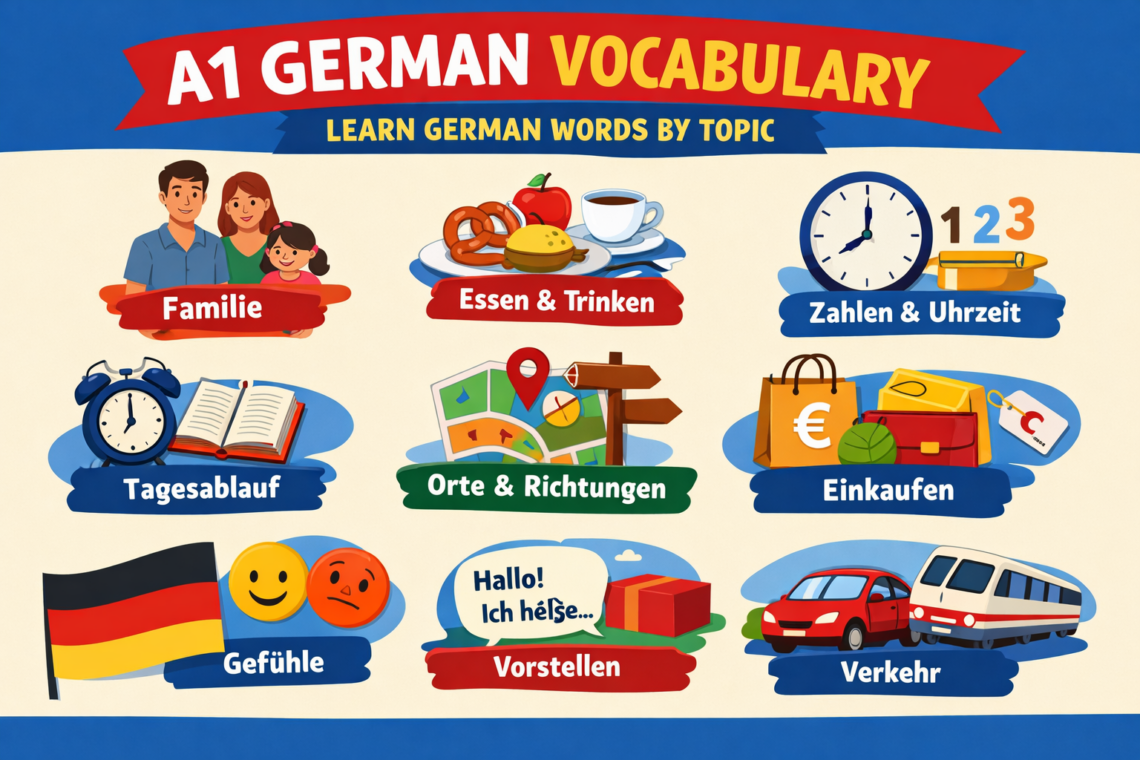
What to Learn as a Beginner
Learning German at A1 level means building vocabulary alongside basic grammar structures so you can form clear, simple sentences. Vocabulary alone is not enough — learners must also understand sentence structure, verb forms, and pronouns to use these words correctly.
This overview introduces the most important A1 German vocabulary topics, while guiding learners to the relevant grammar and skills lessons they need at each stage.
Greetings and Saying Goodbye
At A1 level, learners begin by learning how to greet people and say goodbye politely. These expressions are usually the first complete sentences learners produce, often using very simple sentence patterns.
Common A1 vocabulary
- Hallo
- Guten Morgen
- Guten Abend
- Tschüss
- Auf Wiedersehen
These expressions are best practised together with basic German sentence structure (A1) so learners understand where the verb is placed, even in short phrases.
To hear natural pronunciation and intonation, learners can also watch German greetings and farewells for beginners (A1).
Personal Information & Introductions
This topic allows learners to talk about themselves using basic verbs, pronouns, and present tense forms.
Common A1 vocabulary
- der Name
- kommen aus
- wohnen
- der Beruf
- das Hobby
One of the first communication skills learners practise is how to introduce yourself in German (A1), where they combine vocabulary with German personal pronouns (A1) such as ich and du.
Because these sentences use the present tense, this topic connects directly to German verbs in the present tense (A1) and conjugation of German verbs for beginners.
For listening support, learners can watch How to introduce yourself in German – A1 level.
Family & Relationships
Family vocabulary is frequently used together with possessive articles and pronouns.
Common A1 vocabulary
- die Familie
- die Mutter
- der Vater
- der Bruder
- die Schwester
To form correct sentences like Meine Mutter arbeitet, learners need German personal pronouns and possessive articles (A1) as well as present tense verb conjugation.
This vocabulary is also useful for practising basic negation in German (nicht vs. kein – A1), for example when saying who is not in the family.
You can hear this vocabulary used naturally in Talking about family in German (A1).
Daily Routine & Free Time
This topic helps learners practise verbs in context and talk about repeated daily actions.
Common A1 vocabulary
- aufstehen
- arbeiten
- lernen
- schlafen
- spielen
Many verbs in this topic are separable verbs, which makes it an ideal place to link learners to separable verbs in German (A1).
Because daily routines rely heavily on verbs, learners should study this vocabulary together with German verbs in the present tense (A1) and basic sentence structure.
Examples in spoken German are shown in Daily routine in German – A1 vocabulary and examples.
Food & Drinks
Food vocabulary is essential for everyday life and helps learners practise articles and cases naturally.
Common A1 vocabulary
- das Brot
- der Kaffee
- das Wasser
- essen
- trinken
When learners say Ich trinke Wasser or Ich kaufe ein Brot, they are already using German articles (der, die, das – A1) and touching lightly on German cases at A1 level (mainly nominative and accusative).
Pronunciation and usage are demonstrated in German food and drinks vocabulary for beginners.
Places & Directions
This topic helps learners talk about locations and ask where things are.
Common A1 vocabulary
- die Stadt
- die Straße
- der Bahnhof
- hier
- dort
To ask questions like Wo ist der Bahnhof?, learners need forming questions in German (A1) and a solid understanding of German sentence structure.
Listening practice is available in Asking for directions in German – A1 level.
Shopping & Money
Shopping vocabulary allows learners to practise questions, numbers, and negation.
Common A1 vocabulary
- der Laden
- der Preis
- das Geld
- kaufen
- billig
This topic works well together with basic negation in German (A1), for example when saying Das ist nicht billig or Ich habe kein Geld.
Real-life examples are shown in Shopping in German – A1 vocabulary.
Health, Sickness & Parts of the Body
Health vocabulary is used to describe physical conditions and simple problems.
Common A1 vocabulary
- der Kopf
- der Bauch
- krank
- der Arzt
- weh tun
This topic is often practised together with simple sentence patterns and verb placement, especially when learners describe symptoms.
Pronunciation and examples are explained in German body parts and health vocabulary – A1.
Home, House & Apartment
Learners use this topic to describe where they live and what their home is like.
Common A1 vocabulary
- das Haus
- die Wohnung
- das Zimmer
- die Küche
- wohnen
Sentences in this topic rely heavily on German sentence structure (A1) and present tense verb conjugation.
Examples can be heard in Talking about your home in German – A1.
Clothing, Shoes & Colours
This topic is useful for descriptions and shopping situations.
Common A1 vocabulary
- das Kleid
- die Hose
- die Schuhe
- rot
- blau
Learners often combine this vocabulary with adjectives and basic sentence patterns, which are introduced gradually at A1 level.
Vocabulary usage is demonstrated in German clothing and colours vocabulary for beginners.
Office & Customer Care
This topic introduces learners to basic service and workplace situations.
Common A1 vocabulary
- das Büro
- der Kunde
- helfen
- die Frage
- der Service
Service situations often use polite structures and simple questions, making this a good place to revise forming questions in German (A1) and present tense verb forms.
Examples are explained in Customer service German vocabulary – A1.
Work & Professions
Learners use this topic to talk about jobs and work situations.
Common A1 vocabulary
- der Beruf
- arbeiten
- der Lehrer
- die Firma
- der Job
This topic strongly connects to how to introduce yourself in German (A1) and German verbs in the present tense, especially when talking about what you do.
Pronunciation support is available in German professions and jobs – A1 vocabulary.
School Vocabulary
School vocabulary is useful for students and language learners alike.
Common A1 vocabulary
- die Schule
- der Lehrer
- der Student
- lernen
- das Buch
These sentences are ideal for practising verb conjugation and basic sentence structure, especially with verbs like lernen.
You can hear this vocabulary used in School vocabulary in German – A1 level.
Weather and Seasons
Talking about the weather is a common everyday topic in German, especially when making small talk or describing daily conditions. At A1 level, learners focus on basic weather expressions and the four seasons, using simple adjectives and short sentences.
Common A1 vocabulary
- das Wetter
- sonnig
- kalt
- der Sommer
- der Winter
To build confidence with this topic, learners should study weather and seasons vocabulary in German (A1), where common expressions are explained and used in simple, real-life sentences.
Preparing for the A1 Exam
All of these vocabulary topics come together in listening, reading, writing, and speaking tasks. Learners should revise them together with how to pass the A1 German exam, focusing on clarity rather than perfection.
📄 Download the Expanded Vocabulary PDF
For learners who want all topics with expanded word lists, examples, and structure, you can download the complete A1 German vocabulary PDF for offline study.

A1 German Pronouns Explained Simply

You May Also Like
A1 German Articles Explained
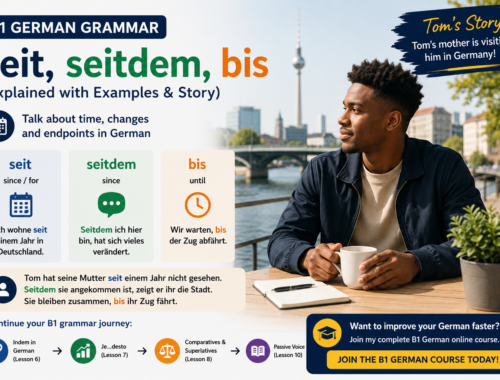
B1 German: How to Use „seit“, „seitdem“ and „bis“ (Explained with Examples & Story)