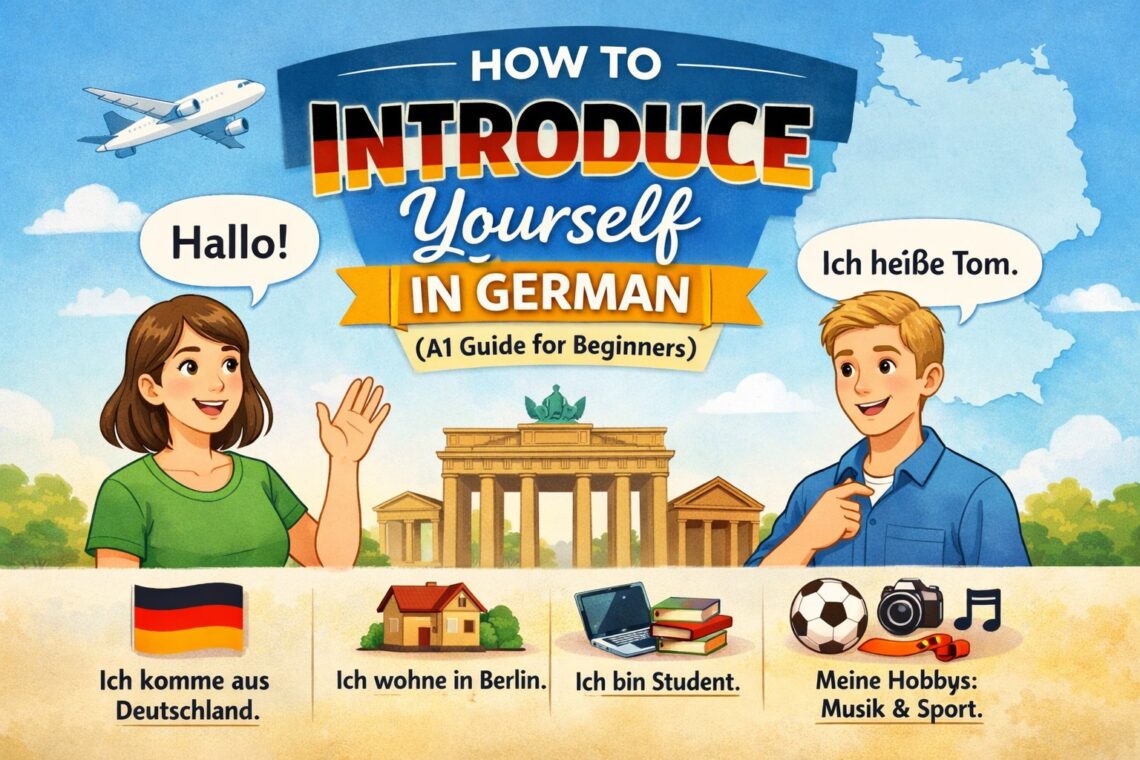
How to Introduce Yourself in German
Being able to introduce yourself in German is one of the very first and most important skills at A1 level. Whether you’re meeting new people, registering for a course, visiting an office, or preparing for an exam, this is something you’ll use again and again.
If you’re completely new to German, it’s best to start with a solid foundation first. Our A1 German basics guide will help you understand how German works before practising full self-introductions.
If you prefer learning with video, you can watch the full explanation of this exam topic on our YouTube channel.
1️⃣ Saying Hello in German
Every introduction starts with a greeting.
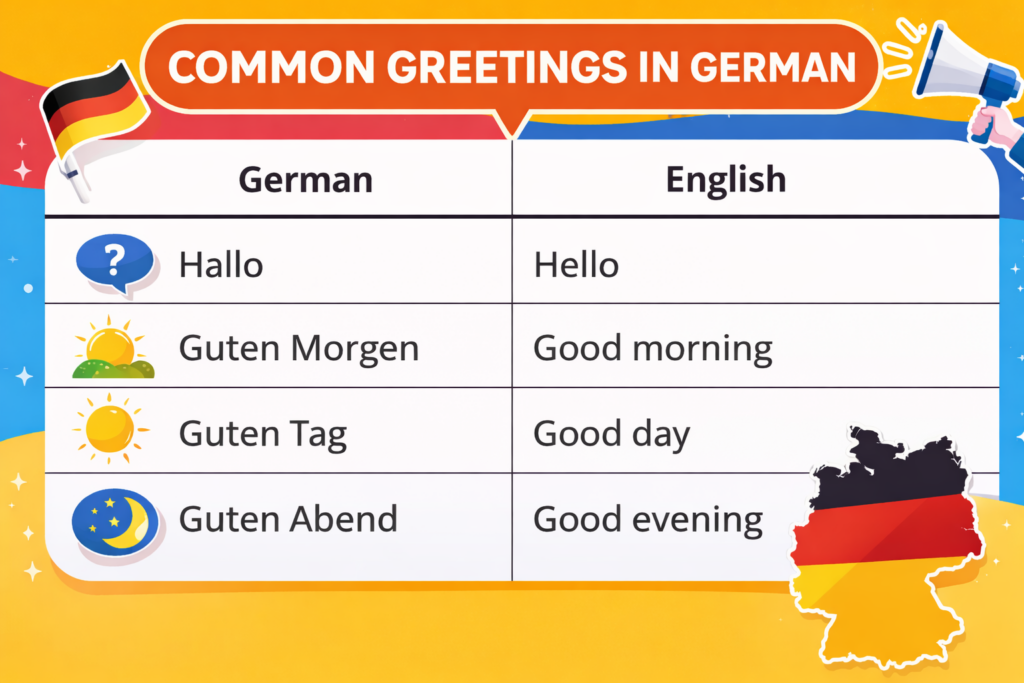
These greetings are part of the most commonly used expressions at beginner level. You’ll find many more useful expressions in our guide to essential German phrases for beginners.
📌 Tip: “Hallo” is safe in almost all situations.
2️⃣ Saying Your Name in German
Asking Someone’s Name
Wie heißt du?
(What is your name?) – informal
Wie heißen Sie?
(What is your name?) – formal
Saying Your Name
Ich heiße Anna.
(My name is Anna.)
Mein Name ist Peter.
(My name is Peter.)
Understanding how these sentences are formed will help you build many similar sentences. This becomes much easier once you understand simple German sentence structure.
3️⃣ Saying Where You Are From
Asking
Woher kommst du?
(Where are you from?)
Answering
Ich komme aus Kenia.
(I am from Kenya.)
Ich komme aus Deutschland.
This verb follows the same pattern as many other common beginner verbs. You can practise this more in our lesson on present tense German verbs for beginners.
4️⃣ Saying Where You Live
Ich wohne in Berlin.
(I live in Berlin.)
Ich wohne in Nairobi.
📌 In German, the verb usually comes in position 2, a key rule you’ll see again and again at A1 level.
5️⃣ Saying What You Do (Job or Study)
You can talk about your job or studies using very simple sentences.
Ich bin Studentin.
(I am a student.)
Ich bin Lehrer.
(I am a teacher.)
Ich arbeite als Ingenieur.
(I work as an engineer.)
You’ll see the same pronouns and verb patterns when learning to describe everyday activities. These are explained in detail in German personal pronouns explained (A1).
6️⃣ Talking About Languages You Speak
Talking about languages is very common when introducing yourself.
Ich spreche Englisch.
(I speak English.)
Ich lerne Deutsch.
(I am learning German.)
Ich spreche ein bisschen Deutsch.
(I speak a little German.)
These sentences belong to everyday vocabulary themes, which you’ll practise more in A1 German vocabulary by topic.
7️⃣ Talking About Personal Details in German (A1)
In real life — especially in courses, offices, registrations, and exams — you may be asked for more personal details. At A1 level, short answers are completely enough.
🔹 Marital Status (Familienstand)
You may hear:
Sind Sie verheiratet?
(Are you married?)
Common answers:
- Ich bin ledig. (I am single.)
- Ich bin verheiratet. (I am married.)
- Ich bin geschieden. (I am divorced.)
📌 One simple sentence is perfect at A1 level.
🔹 Talking About Hobbies (Hobbys)
A friendly and very common question:
Was sind Ihre Hobbys?
(What are your hobbies?)
Simple answers:
- Meine Hobbys sind Lesen und Reisen.
- Ich lese gern.
- Ich höre gern Musik.
- Ich mache gern Sport.
📌 “gern” means like / enjoy.
You’ll use this a lot when talking about daily life, which you can practise further in A1 German vocabulary by topic.
🔹 Giving Your Address (Adresse)
You may be asked:
Wo wohnen Sie?
or
Wie ist Ihre Adresse?
Example answer:
Ich wohne in der Hauptstraße 10, Berlin.
📌 You do not need to spell the address unless asked.
🔹 Giving Your Telephone Number (Telefonnummer)
Common question:
Wie ist Ihre Telefonnummer?
Answer:
Meine Telefonnummer ist 0712 345678.
📌 Say numbers slowly and clearly.
You can practise number patterns in A1 German exercises for beginners.
🔹 First Name and Last Name (Vorname & Nachname)
In official situations, you may hear:
Wie ist Ihr Vorname?
Wie ist Ihr Nachname?
Answers:
- Mein Vorname ist Anna.
- Mein Nachname ist Müller.
These questions are very common in offices, schools, and exams.
8️⃣ A Complete A1 Self-Introduction (Extended Example)
Here is a realistic A1-level self-introduction using all the elements above:
Hallo!
Ich heiße Maria Müller.
Mein Vorname ist Maria, mein Nachname ist Müller.
Ich komme aus Kenia.
Ich wohne in Nairobi.
Ich bin verheiratet.
Meine Hobbys sind Lesen und Reisen.
Ich spreche Englisch und ich lerne Deutsch.
✅ This is fully A1-appropriate — simple, clear, and correct.
9️⃣ Formal vs Informal German
| Informal | Formal |
|---|---|
| du | Sie |
| Wie heißt du? | Wie heißen Sie? |
| Woher kommst du? | Woher kommen Sie? |
📌 Use Sie in professional or official situations.
✍️ Practice Exercises (A1 Level)
Exercise 1: Fill in the blanks
- Ich ___ Anna.
- Ich ___ aus Deutschland.
- Ich ___ Deutsch.
Answers: heiße – komme – spreche
Exercise 2: Write About Yourself
Write 5–6 short sentences in German:
- Name (Vorname & Nachname)
- Country
- City
- Marital status
- One hobby
Exercise 3: Speaking Practice
Say this out loud:
Ich heiße …
Ich wohne in …
Meine Hobbys sind …
For more guided practice like this, continue with A1 German exercises for beginners.
How This Helps You Progress
Once you can introduce yourself confidently, you are ready to:
- Ask and answer simple questions
- Talk about daily routines
- Handle A1 speaking tasks
After mastering A1 basics, many learners move on to A1 German exam preparation as their next major goal.
Final Thoughts
Introducing yourself in German doesn’t require complex grammar — just clear, simple sentences and regular practice. Use these phrases often, say them out loud, and don’t be afraid to make mistakes.
With consistency, this will quickly feel natural.


You May Also Like

A1 German Pronunciation Guide (Alphabet, Sounds & Common Mistakes)
B1 German: How to Use „indem“ (Explained with Examples & Story)