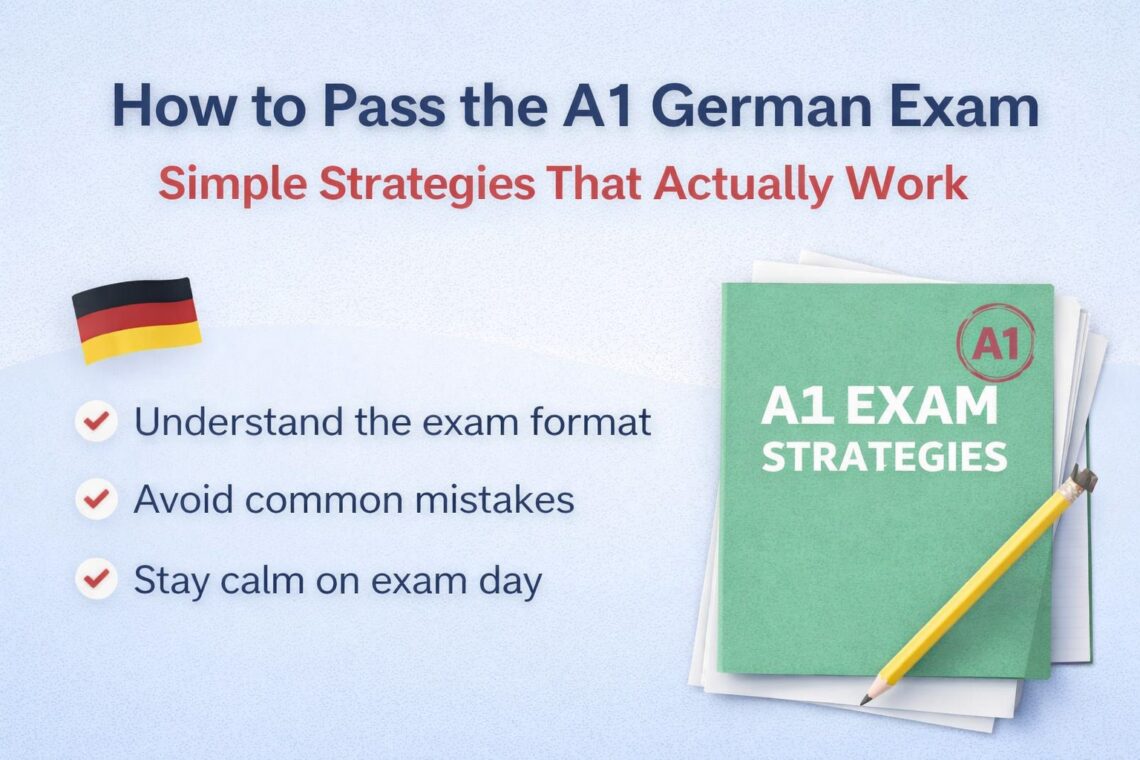
How to Pass the A1 German Exam
Simple Strategies That Actually
The A1 German exam is the very first official step in learning German. For many learners, it feels intimidating however, A1 is absolutely manageable, even if you are a complete beginner.
Before preparing for the exam, it’s important to build a solid foundation in A1 German basics.
In this guide, you’ll learn:
- What the A1 exam really tests
- How each exam part works
- Simple, realistic strategies to help you pass
- What examiners actually expect from you
What Is the A1 German Exam?
The A1 level shows that you can:
- Understand and use very basic German expressions
- Introduce yourself and others
- Ask and answer simple questions
- Communicate in everyday situations
A1 exams are offered by institutions such as the Goethe-Institut, telc, and ÖSD.
While formats may vary slightly, the skills tested are the same.
These skills are developed step by step through German for complete beginners’ guide which includes beginner grammar, vocabulary, and speaking practice guides.
Structure of the A1 German Exam
📖 1. Reading (Lesen)
You will read:
- Short texts
- Notices
- Simple emails or messages
You are tested on:
- Names
- Times
- Prices
- Places
- Basic information
Example reading task:
Lesen Sie den Text. Wann beginnt der Kurs?
“Der Deutschkurs beginnt um 9:00 Uhr.”
✅ Correct answer: 9:00 Uhr
📌 Tip: Don’t translate every word. Look for numbers, names, and keywords.
Reading tasks become easier when you are familiar with basic sentence patterns.
🎧 2. Listening (Hören)
You will listen to:
- Short conversations
- Announcements
- Simple dialogues
Tasks include:
- Multiple choice
- True/false questions
Example listening situation:
You hear a conversation in a shop.
Question: Was kauft die Frau?
Possible answers: Brot / Milch / Kaffee
📌 Tip: Read the questions before listening so you know what to focus on.
Regular listening practise with the help of A1 German listening tips for beginners helps you recognise words faster during the exam.
✍️ 3. Writing (Schreiben)
You usually need to write:
- A very short text (about 30–50 words)
Common tasks include:
- Writing a short message
- Filling out a form
- Sending a simple email
Example writing task:
Teil 2 – Kurzer Text (ca. 30 Wörter)
Sie möchten im Juli Köln besuchen.
Schreiben Sie an die Touristeninformation:
- Warum schreiben Sie?
- Bitten Sie um Informationen (Sehenswürdigkeiten).
- Fragen Sie nach Hotels.
➡️ Schreiben Sie eine Anrede und einen Gruß.
📌 Important:
- Simple sentences are enough
- Minor grammar mistakes are allowed
- Clarity matters more than perfection
Sample Answer (ca. 30 Wörter)
Sehr geehrte Damen und Herren,
ich möchte im Juli Köln besuchen.
Bitte schicken Sie mir Informationen über Sehenswürdigkeiten.
Haben Sie Hoteladressen?
Mit freundlichen Grüßen
Maria Schmidt
Writing short, clear sentences is easier when you understand basic verb forms and negation.
🗣️ 4. Speaking (Sprechen)
This part is very simple and friendly. You may be asked to:
- Introduce yourself
- Answer basic questions
- Ask simple questions
Typical speaking task:
Bitte stellen Sie sich vor.
Example:
Ich heiße Paul.
Ich komme aus Kenia.
Ich wohne in Nairobi.
Ich lerne Deutsch.
📌 Tip: Speak slowly and clearly. You are not expected to speak fluently at A1.
Speaking tasks at A1 are based on fixed phrases and simple self-introductions.
How to Prepare for the A1 German Exam
1. Focus on Everyday German
A1 is about real life, not complicated grammar.
Learn how to talk about:
- Yourself
- Family
- Food
- Time
- Daily activities
- Shopping
- Hobbies
- School
2. Learn Essential Grammar Only
At A1 level, you need:
- Present tense verbs
- Personal pronouns
- Articles (der, die, das)
- Simple questions
- Word order in statements
📌 You do NOT need advanced grammar to pass.
3. Build Basic Vocabulary
Focus on high-frequency words such as:
- Numbers
- Days & time
- Food & drinks
- Places
- Common verbs (gehen, kommen, haben, sein)
📌 Learn vocabulary in short sentences, not lists.
Learning vocabulary by topic is more effective than memorising isolated word lists.
✅ 4. Practice Speaking From Day One
Even alone, you can:
- Describe pictures
- Talk about your day
- Introduce yourself out loud
Confidence matters more than accuracy at A1.
Mini Practice Exercises
🧩 Exercise 1: Reading
Read the sentence:
Ich heiße Lukas und komme aus Berlin.
Aufagabe:
Woher kommt Lukas?
✅ Antwort: Lukas kommt aus Berlin
✍️ Exercise 2: Writing
Write 3–4 sentences about:
- Your name
- Where you live
- What languages you speak
🗣️ Exercise 3: Speaking
Answer aloud:
- Wie heißen Sie?
- Wo wohnen Sie?
- Was machen Sie gern?
Regular short exercises in form of Grammar Workbooks with answers help you feel more confident before the exam.
Common Reasons Learners Fail the A1 Exam
🚫 Trying to speak perfectly
🚫 Panicking during listening
🚫 Not practicing writing
🚫 Studying grammar without speaking
🚫 Not knowing the exam format
The solution? Simple practice and calm preparation.
Final Tips for Exam Day
✔ Arrive early
✔ Read instructions carefully
✔ Don’t leave answers empty
✔ Speak confidently, even with mistakes
✔ Stay calm — A1 is designed for beginners
Conclusion
The A1 German exam is not about being perfect. It is about showing that you can communicate in simple, everyday situations.
With basic grammar, useful vocabulary, and regular practice, you can pass the A1 exam with confidence.
If you’d like extra practice before the exam, you can explore our A1 German exam resources, including mock exams designed for beginners.



2 Comments
Kyles Muthoni
Danke
Frau Kolb
Bitte Schön.