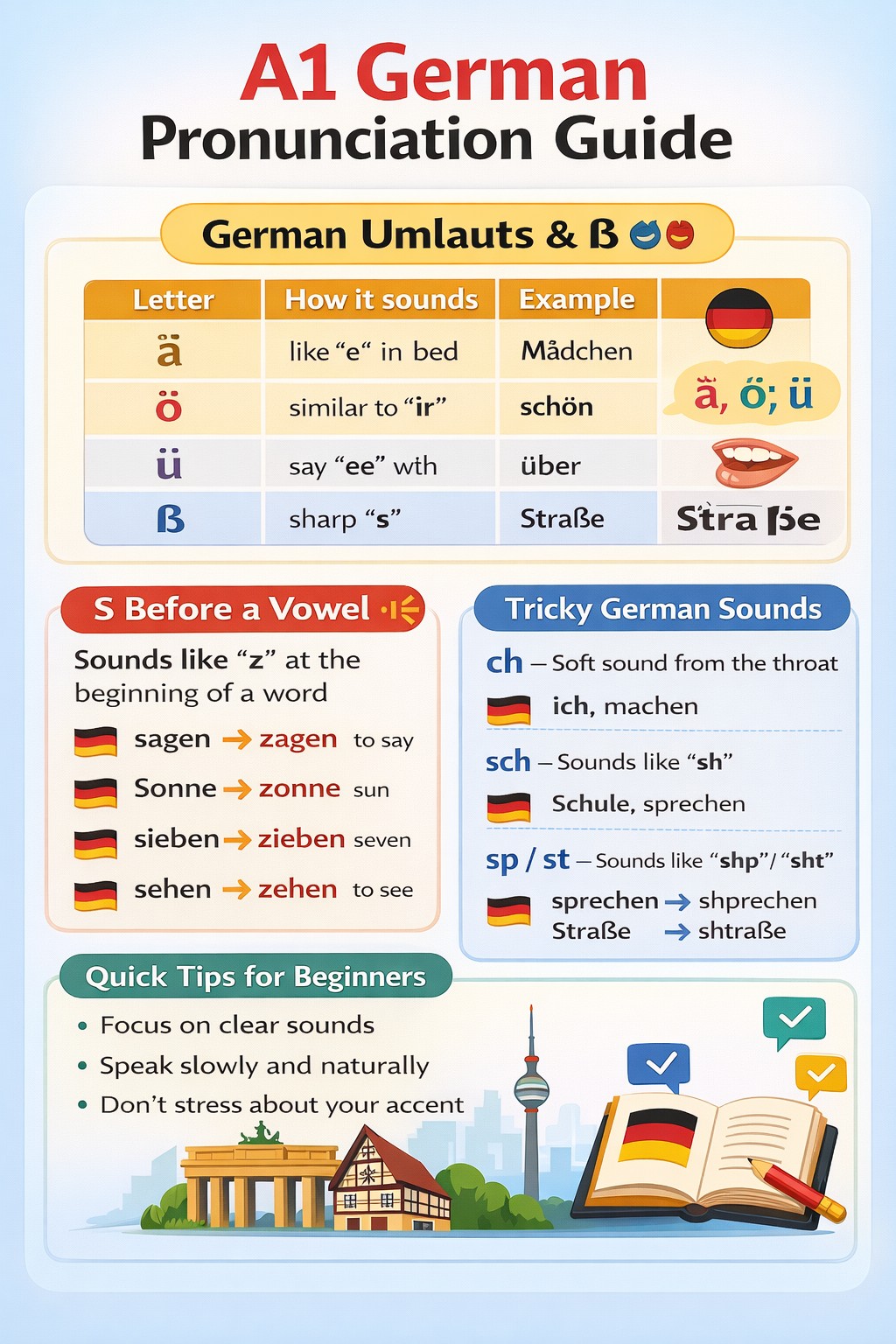
A1 German Pronunciation Guide (Alphabet, Sounds & Common Mistakes)
German pronunciation often feels intimidating for beginners, especially because some sounds do not exist in English. The good news is that German pronunciation is logical and consistent. Once you learn the basic rules, most words are pronounced exactly as written.
If you are just starting out, this guide works best together with our A1 German basics for complete beginners, where you learn how pronunciation fits into overall sentence building.
Does German Use the Same Alphabet as English?
Yes. German uses the Latin alphabet (A–Z), just like English. However, some letters and sounds are pronounced differently.
At A1 level, you should focus on:
- Clear vowel sounds
- Correct pronunciation of special letters
- Being understandable, not perfect
Pronunciation improves naturally as you begin forming sentences. You can our video on German Alphabet and pronounciation tips if you’re one who understands better by listening.
Special German Letters You Must Know (Umlauts & ß)
German has four special letters that change pronunciation.
| Letter | How it sounds | Example |
|---|---|---|
| ä | like “e” in bed | Mädchen |
| ö | no English equivalent | schön |
| ü | no English equivalent | über |
| ß | sharp “s” | Straße |
These letters appear very often in beginner vocabulary, especially when learning A1 German vocabulary by topic.
How to Pronounce German Umlauts (ä, ö, ü)
ä (ä, Ä)
- Similar to “e” in bed
- Never pronounced like “a” in cat
Examples:
- Mädchen
- spät
- ändern
ö (ö, Ö)
- No exact English sound
- Say “eh” and round your lips
Examples:
- schön
- hören
- können
ü (ü, Ü)
- Say “ee” and round your lips tightly
- Use a mirror to check lip position
Examples:
- über
- fünf
- fühlen
Umlauts often appear in beginner sentences when practicing present tense German verbs for beginners.
The Letter ß (Eszett)
- Pronounced like a sharp “s”
- Never pronounced like “z” or “sh”
- Often appears after long vowels
Examples:
- Straße
- groß
- heißen
The Sound of S in German (Very Important A1 Rule)
S before a vowel (at the beginning of a word)
When s comes before a vowel at the beginning of a word, it is pronounced like “z”.
Examples:
- sagen → zagen
- Sonne → zonne
- sieben → zieben
This rule helps greatly when speaking and asking questions using essential German phrases for A1 beginners.
S in the middle or end of a word
Pronounced like a soft “s”.
Examples:
- Haus
- Maus
- lesen
ss or ß
Always pronounced like a sharp “s”.
Examples:
- Wasser
- Straße
- groß
Important German Letter Combinations (A1 Level)
ch
- Soft sound from the throat
- Never pronounced like “ch” in chair
Examples:
- ich
- machen
- sprechen
You will hear this sound frequently when practicing A1 German listening tips for beginners.
sch
- Pronounced like “sh”
Examples:
- Schule
- schön
- sprechen
sp / st (at the beginning of words)
Pronounced “shp” and “sht”.
Examples:
- sprechen → shprechen
- Straße → shtraße
German Vowel Length (Short vs Long Vowels)
Vowel length can change the meaning of a word.
Examples:
- bitten (short i) → to ask
- bieten (long i) → to offer
Word Stress in German
German word stress is usually:
- On the first syllable
- On the main part of the word, not prefixes
Examples:
- LERnen
- ARbeiten
- DEUTschland
Correct stress helps your pronunciation sound natural even if grammar is not perfect.
Common A1 Pronunciation Mistakes
🚫 Pronouncing umlauts like English vowels
🚫 Saying “s” like English “s” at the beginning of words
🚫 Pronouncing ch like chair
🚫 Ignoring vowel length
These mistakes are normal and improve with regular practice.
Pronunciation Practice (Beginner Exercise)
Say each word slowly and clearly:
- fünf
- schön
- über
- Straße
- Sonne
- ich lerne Deutsch
Then try building full sentences using A1 German practice exercises with answers.
Do You Need Perfect Pronunciation at A1?
No.
Language exams and courses offered by the Goethe-Institut focus on:
- Clear sounds
- Understandable speech
- Basic communication
Accent perfection is not required at A1 level.
What to Learn Next After Pronunciation
Once you feel comfortable with pronunciation, the next steps are:
- Sentence structure
- Present tense verbs
- Asking simple questions
These topics prepare you for moving toward A1 German exam preparation guide later on.
Final Tip for Beginners
Speak early.
Speak slowly.
Focus on clarity, not perfection.
German pronunciation becomes easier the more you hear and use the language.


You May Also Like

A2 German Explained: What You Learn and How to Progress
How to Pass the A2 German Exam