A1 German Modal Verbs Explained (können, müssen, wollen & möchten)
German modal verbs are essential at A1 level because they help you express:
- what you can do
- what you must do
- what you want or would like to do
You will hear modal verbs in almost every everyday German conversation. At A1 level, the goal is clear communication, not perfect grammar.
If you’re completely new to German, start with an overview of the level first:
👉 A1 German basics for complete beginners
What Are Modal Verbs in German?
Modal verbs are verbs that modify another verb. They express:
- ability
- obligation
- intention
- permission
- preference
The most important modal verbs at A1 level are:
- können – can, to be able to
- müssen – must, to have to
- wollen – to want
- sollen – should
- dürfen – may, to be allowed to
- mögen – to like
In everyday German, you will also use möchten, which needs a special explanation (see below).
How German Modal Verbs Work (A1 Rule)
German modal verbs appear with two verbs:
- the modal verb (conjugated)
- the main verb (infinitive)
Basic structure:
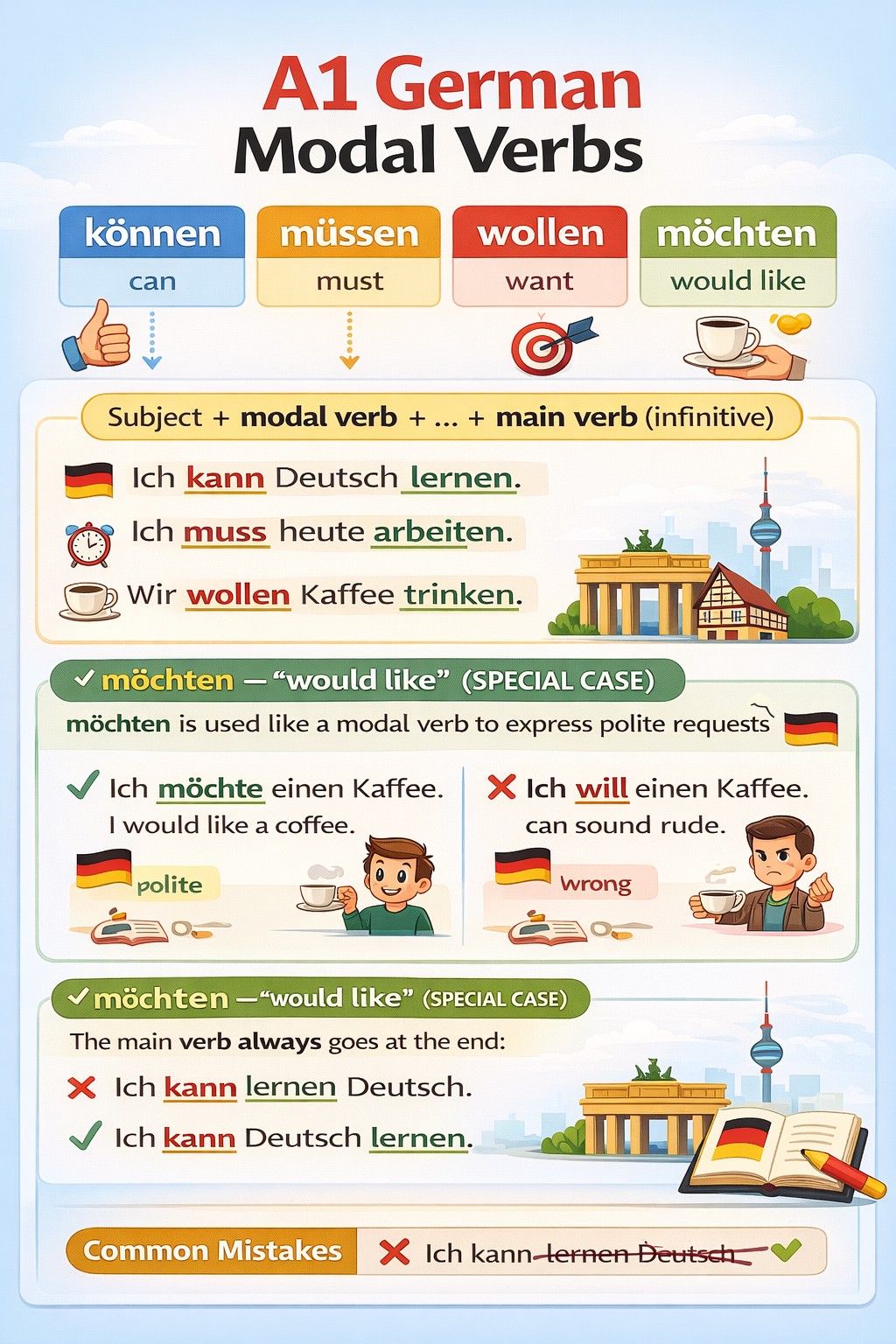
Subject + modal verb + rest of sentence + main verb (infinitive)
This structure is based on simple German sentence structure, especially verb position.
👉 simple German sentence structure explained
Examples:
- Ich kann Deutsch lernen.
- Ich muss heute arbeiten.
- Wir wollen Kaffee trinken.
📌 Important: the main verb always goes to the end.
The Most Important A1 German Modal Verbs
🔹 können – “can / to be able to”
Used to express ability or possibility.
Examples:
- Ich kann Deutsch sprechen.
- Kannst du mir helfen?
This verb appears very often in essential German phrases for A1 beginners.
👉 essential German phrases for A1 beginners
🔹 müssen – “must / to have to”
Used for obligation or necessity.
Examples:
- Ich muss lernen.
- Wir müssen arbeiten.
🔹 wollen – “to want”
Used to express strong intention.
Examples:
- Ich will Deutsch lernen.
- Was willst du trinken?
📌 Note: wollen can sound direct or strong in everyday situations.
🔹 sollen – “should”
Used for advice or instructions.
Examples:
- Du sollst mehr lernen.
- Wir sollen pünktlich sein.
🔹 dürfen – “may / to be allowed to”
Used to ask for or give permission.
Examples:
- Ich darf hier sitzen.
- Darf ich fragen?
🔹 möchten – “would like” (SPECIAL CASE)
Although möchten is not technically a modal verb, it is taught together with modal verbs at A1 level because it behaves in the same way.
What is möchten?
- möchten is the polite form of mögen
- It expresses a wish or polite request
- It is very common in everyday German
Examples:
- Ich möchte einen Kaffee.
- Wir möchten Deutsch lernen.
- Möchtest du etwas trinken?
📌 Important for beginners:
You do not need to learn Konjunktiv II grammar at A1 level.
Just remember:
möchten works like a modal verb in sentence structure
wollen vs möchten (Very Important!)
| Verb | Meaning | Tone |
|---|---|---|
| wollen | to want | direct / strong |
| möchten | would like | polite / friendly |
Example:
- 🚫 Ich will einen Kaffee. (can sound rude)
- ✅ Ich möchte einen Kaffee. (polite and natural)
This distinction is essential in daily life.
Verb Position with Modal Verbs
With modal verbs (and möchten):
- the modal verb is in position 2
- the main verb is at the end
Examples:
- Heute muss ich Deutsch lernen.
- Zu Hause möchte ich ruhig arbeiten.
This builds directly on present tense German verbs for beginners.
👉 present tense German verbs for beginners → /a1-german-present-tense-verbs/
Questions with Modal Verbs (A1)
For yes/no questions:
Modal verb + subject + rest + main verb?
Examples:
- Kann ich hier sitzen?
- Musst du heute arbeiten?
- Möchtest du etwas trinken?
Learn more about question forms here:
👉 asking simple questions in German (A1)
Common A1 Mistakes with Modal Verbs
🚫 Ich kann lernen Deutsch.
✅ Ich kann Deutsch lernen.
🚫 Ich muss arbeite.
✅ Ich muss arbeiten.
🚫 Ich will höflich sein.
✅ Ich möchte höflich sein.
Practice Section
✍️ Exercise: Choose the Correct Verb
- Ich ___ Deutsch lernen. (can)
- Wir ___ heute arbeiten. (must)
- Ich ___ einen Tee. (would like)
Answers:
- kann
- müssen
- möchte
For more practice, see:
👉 A1 German practice exercises with answers
Final Thoughts
At A1 level, focus especially on:
- können
- müssen
- möchten
These three verbs will already allow you to communicate politely and effectively in many everyday situations.


You May Also Like

A1 German Pronunciation Guide (Alphabet, Sounds & Common Mistakes)
How to Pass the A2 German Exam