Wechselpräpositionen Explained Simply (A2 German)
One of the most confusing grammar topics at A2 level is Wechselpräpositionen.
Many learners ask:
- Why is it “in der Küche” sometimes and “in die Küche” other times?
- How do I know when to use dative or accusative?
The good news is:
👉 At A2 level, Wechselpräpositionen are very logical when you learn them step by step.
In this post, you will learn:
- what Wechselpräpositionen are
- when to use dative and when to use accusative
- how to describe your home and everyday situations correctly
All explanations and examples are strictly A2 level.
1. What Are Wechselpräpositionen? (A2)
Wechselpräpositionen are prepositions that can use:
- Dative
- Accusative
The most important Wechselpräpositionen at A2 level are:
| German | English |
|---|---|
| in | in |
| auf | on |
| an | on / at |
| unter | under |
| über | over |
| vor | in front of |
| hinter | behind |
| zwischen | between |
| neben | next to |
2. The Most Important Rule (A2 Friendly)
The key question is:
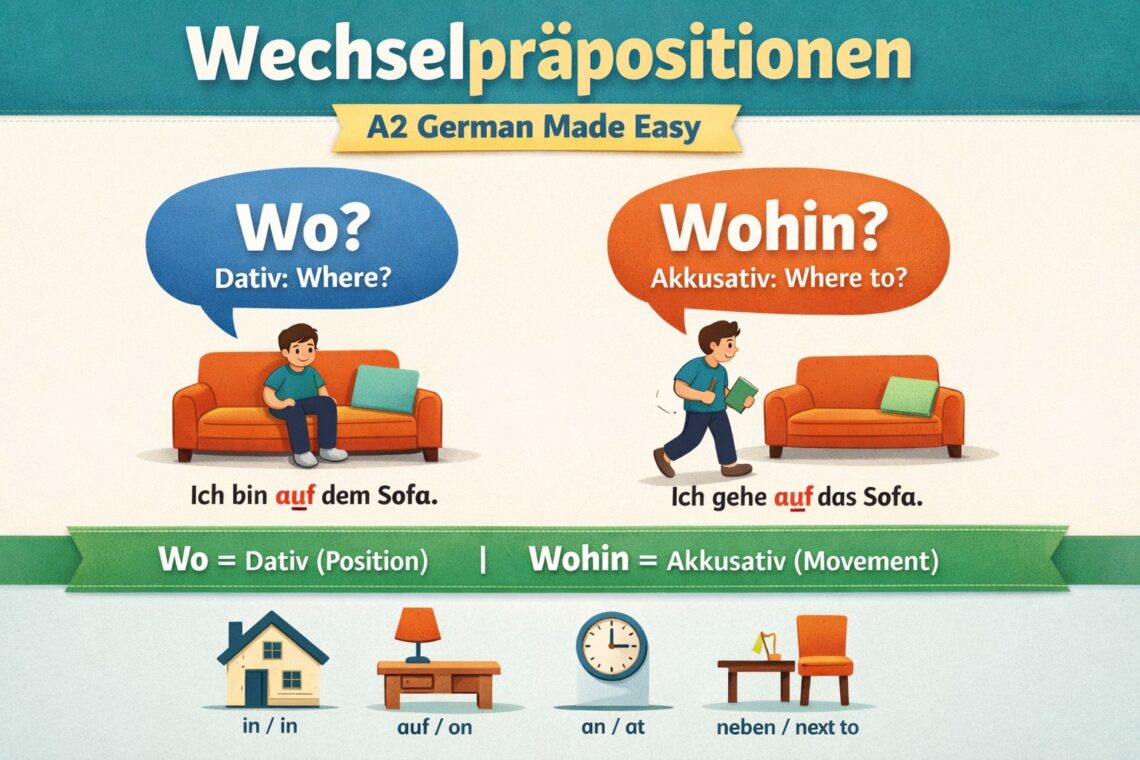
❓ Wo? oder Wohin?
| Question | Case | Meaning |
|---|---|---|
| Wo? | Dative | position (no movement) |
| Wohin? | Accusative | movement / direction |
This rule works in most A2 situations.
3. Using Wechselpräpositionen with Wo? (Dative)
Use dative when something is already in a place.
Examples (A2)
- Ich bin in der Küche.
- Das Buch liegt auf dem Tisch.
- Der Stuhl steht neben dem Bett.
These sentences answer the question Wo? (Where?).
📌 Tip:
Words like liegen, stehen, sein usually go with Wo?.
4. Using Wechselpräpositionen with Wohin? (Accusative)
Use accusative when there is movement from one place to another.
Examples (A2)
- Ich gehe in die Küche.
- Ich stelle das Buch auf den Tisch.
- Ich setze mich neben den Stuhl.
These sentences answer Wohin? (Where to?).
📌 Tip:
Verbs like gehen, stellen, legen, setzen often mean movement.
5. Very Common A2 Pairs (Learn These!)
These pairs are extremely important at A2 level:
| Dative (Wo?) | Accusative (Wohin?) |
|---|---|
| in der Küche | in die Küche |
| auf dem Tisch | auf den Tisch |
| an der Wand | an die Wand |
Try to learn them together, not alone.
6. Stehen oder Stellen? (Very Important at A2)
Many learners are unsure when to use stehen or stellen, especially with furniture.
🔹 Stehen – No Movement
Use stehen when something:
- is already in a place
- does not move
Stehen = to be / to be located
Examples:
- Der Tisch steht in der Küche.
- Das Sofa steht im Wohnzimmer.
- Die Lampe steht auf dem Tisch.
📌 Furniture often uses stehen.
🔹 Stellen – Movement
Use stellen when someone:
- puts something somewhere
- changes the position
Stellen = to put / to place
Examples:
- Ich stelle den Tisch in die Küche.
- Sie stellt die Lampe auf den Tisch.
- Wir stellen das Sofa ins Wohnzimmer.
🔹 Stehen vs Stellen – Quick Overview
| Situation | Verb | Example |
|---|---|---|
| No movement | stehen | Der Tisch steht in der Küche. |
| Movement | stellen | Ich stelle den Tisch in die Küche. |
💡 Ask yourself:
Does something move?
- No → stehen
- Yes → stellen
7. Describing Your Home in Simple Sentences
Now you can describe your home step by step.
Useful Sentence Patterns
- Ich wohne in einer Wohnung.
- Meine Wohnung ist klein, aber schön.
- Es gibt ein Wohnzimmer und eine Küche.
- Das Sofa steht im Wohnzimmer.
Example Description
Ich wohne in einer kleinen Wohnung.
Es gibt ein Wohnzimmer und ein Schlafzimmer.
Das Sofa steht im Wohnzimmer.
Die Küche ist klein, aber hell.
8. Mini Dialogue (A2)
A: Wo wohnst du?
B: Ich wohne in einer Wohnung.
A: Wie ist deine Wohnung?
B: Sie ist klein, aber schön.
9. Practice (A2)
Exercise 1: Choose the Correct Verb
- Das Sofa ___ im Wohnzimmer.
- Ich ___ den Stuhl neben den Tisch.
✔ Answers:
- steht
- stelle
Exercise 2: Complete the Sentences
- Ich wohne in einer ___ Wohnung. (small)
- Der Tisch ___ in der Küche.
Exercise 3: Speaking Practice
Say aloud:
- Ich wohne in …
- Der Tisch steht …
- Ich stelle den Stuhl …
10. Summary
You can now:
- name rooms and furniture
- say where things are
- use wo / wohin
- choose stehen or stellen correctly
Simple sentences are enough to describe your home well.
Learn German Step by Step
If you want structured A2 German lessons with:
- videos
- vocabulary lists
- workbooks and quizzes
- speaking practice
you can explore my full A2 German course.


You May Also Like

Asking Simple Questions in German

GESAMMELTE VERB-FAMILIEN mit vielen Präfixen.