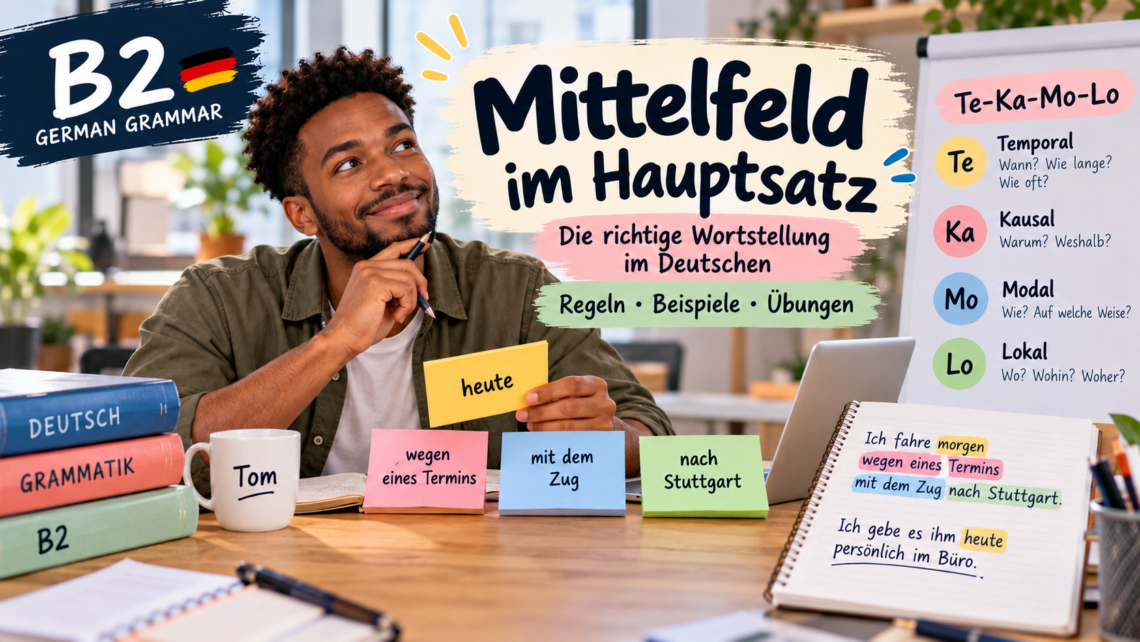
Mittelfeld im Hauptsatz: Die richtige Wortstellung im Deutschen (B2)
1. What is the Mittelfeld in German?
Have you ever tried to build a long German sentence and wondered where to put the time, the reason, the manner, the place and the objects?
You are not alone! German word order can be challenging, especially when you want to express several ideas in one grammatically correct sentence.
The good news is that there are patterns you can learn and practise.
In German grammar, a main clause (Hauptsatz) can be divided into different parts. Three important concepts are:
- Vorfeld: The position before the conjugated verb.
- Linke Satzklammer: The position occupied by the finite verb in a main clause.
- Mittelfeld: The area after the left sentence bracket and before the right sentence bracket, if there is one.
Consider this example:
Ich habe meinem Kollegen gestern wegen eines wichtigen Projekts ausführlich im Büro geholfen.
| Satzteil | Example |
|---|---|
| Vorfeld | Ich |
| Linke Satzklammer | habe |
| Mittelfeld | meinem Kollegen gestern wegen eines wichtigen Projekts ausführlich im Büro |
| Rechte Satzklammer | geholfen |
The Mittelfeld contains several pieces of information: the person receiving help, the time, the reason, the manner and the place.
In a sentence with only one finite verb, the Mittelfeld follows that verb and extends towards the end of the clause.
For example:
Ich erkläre meinem Kollegen heute die Aufgabe.
Here, erkläre is the finite verb, and the other sentence elements belong to the Mittelfeld.
The important point is that German allows some flexibility in the order of these elements, but certain patterns help you construct clear, natural sentences.
2. The Te-Ka-Mo-Lo rule
One of the most useful guidelines for organising adverbial information in German is Te-Ka-Mo-Lo.
The abbreviation stands for:
- Te – Temporal: When? How long? How often?
- Ka – Kausal: Why? For what reason?
- Mo – Modal: How? In what way?
- Lo – Lokal: Where? Where to? Where from?
The usual neutral order is:
Temporal → Kausal → Modal → Lokal
Te – Temporal: Wann?
Temporal information tells us when, how long or how often something happens.
Examples:
- heute – today
- gestern – yesterday
- jeden Morgen – every morning
- am Wochenende – at the weekend
- zwei Stunden lang – for two hours
Example:
Ich lerne heute Deutsch.
Ka – Kausal: Warum?
Causal information explains why something happens.
Examples:
- wegen des Wetters – because of the weather
- aus beruflichen Gründen – for professional reasons
- aufgrund eines Problems – because of a problem
Example:
Ich lerne heute wegen meiner Prüfung Deutsch.
Mo – Modal: Wie?
Modal information describes how an action takes place.
Examples:
- sorgfältig – carefully
- mit großer Geduld – with great patience
- gemeinsam – together
- mit dem Zug – by train
Example:
Ich lerne heute wegen meiner Prüfung sehr konzentriert.
Lo – Lokal: Wo? Wohin? Woher?
Local information describes the place or direction.
Examples:
- im Büro – in the office
- nach Berlin – to Berlin
- aus der Schule – from school
- in der Bibliothek – in the library
Example:
Ich lerne heute wegen meiner Prüfung sehr konzentriert in der Bibliothek.
Putting Te-Ka-Mo-Lo together
Consider this sentence:
Ich fahre morgen wegen eines wichtigen Termins mit dem Zug nach Stuttgart.
| Element | Sentence part | Question |
|---|---|---|
| Te | morgen | Wann? |
| Ka | wegen eines wichtigen Termins | Warum? |
| Mo | mit dem Zug | Wie? |
| Lo | nach Stuttgart | Wohin? |
This order creates a clear, neutral sentence.
Here is another example:
Sie arbeitet jeden Tag wegen ihrer Prüfung sehr konzentriert in der Bibliothek.
- Te: jeden Tag
- Ka: wegen ihrer Prüfung
- Mo: sehr konzentriert
- Lo: in der Bibliothek
Important: Te-Ka-Mo-Lo is a guideline for ordering adverbial information. It does not determine the position of every object in the sentence, and it is not an absolute rule. Pronouns, objects, emphasis and context can influence the order.
Is Te-Ka-Mo-Lo always compulsory?
No. German word order is flexible enough to allow other arrangements when the speaker wants to emphasise a particular element or connect the sentence to what has already been said.
Compare:
Heute fahre ich mit dem Zug nach Berlin.
Nach Berlin fahre ich heute mit dem Zug.
Both sentences are grammatically correct. In the second sentence, the destination is placed first for emphasis or because it is the main topic of the conversation.
For additional revision of cases and prepositional phrases, read our article on Wechselpräpositionen: Explained Simply (A2).
3. The position of different sentence elements
The Mittelfeld can contain several kinds of elements:
- Dative objects
- Accusative objects
- Temporal, causal, modal and local expressions
- Negation, such as nicht
- Other information needed to complete the meaning of the sentence
Consider this example:
Die Lehrerin erklärt den Schülern heute die Grammatik sehr geduldig im Klassenzimmer.
The sentence contains:
- Subject: die Lehrerin
- Finite verb: erklärt
- Dative object: den Schülern
- Temporal information: heute
- Accusative object: die Grammatik
- Modal information: sehr geduldig
- Local information: im Klassenzimmer
The example illustrates how different elements can appear in the Mittelfeld.
However, remember that Te-Ka-Mo-Lo is not a universal formula for the entire sentence. The position of objects depends on their grammatical form and on the information structure of the sentence.
For instance:
Die Lehrerin erklärt den Schülern heute die Grammatik.
Die Lehrerin erklärt sie ihnen heute.
Both sentences are correct, but the order of the objects changes when nouns are replaced with pronouns.
Let’s examine this in more detail.
4. Dativ and Akkusativ in the Mittelfeld
German verbs can take different kinds of objects. Two common types are the dative object and the accusative object.
The dative object often answers the question Wem? (To whom?).
The accusative object often answers the question Wen oder was? (Whom or what?).
For example:
Ich gebe meinem Bruder das Buch.
- Wem gebe ich das Buch? – Meinem Bruder. (Dativ)
- Was gebe ich meinem Bruder? – Das Buch. (Akkusativ)
The usual order depends on whether the objects are nouns or pronouns.
A. Two nouns: Dativ usually comes before Akkusativ
When both objects are full noun phrases, the dative object usually comes before the accusative object.
Examples:
Ich gebe meinem Bruder das Buch.
Die Lehrerin erklärt den Schülern die Aufgabe.
Sie zeigt ihrer Kollegin den Bericht.
This is the usual neutral order in German.
B. Two pronouns: Akkusativ usually comes before Dativ
When both objects are pronouns, the accusative pronoun generally comes before the dative pronoun.
Examples:
Ich gebe es ihm.
- es = Akkusativ
- ihm = Dativ
Die Lehrerin erklärt sie ihnen.
- sie = Akkusativ
- ihnen = Dativ
Sie zeigt ihn ihr.
- ihn = Akkusativ
- ihr = Dativ
Compare the two patterns:
| Two nouns | Two pronouns |
|---|---|
| Ich gebe dem Mann das Buch. | Ich gebe es ihm. |
| Sie zeigt der Kollegin den Bericht. | Sie zeigt ihn ihr. |
| Er erklärt den Kindern die Regel. | Er erklärt sie ihnen. |
This distinction is especially important when building longer sentences.
C. One noun and one pronoun
When one object is a pronoun and the other is a noun phrase, the pronoun usually comes first.
Examples:
Ich gebe ihm das Buch.
Ich gebe es meinem Bruder.
Sie erklärt ihnen die Aufgabe.
Sie erklärt sie den Schülern.
The general patterns to remember are:
- Two nouns: dative usually before accusative.
- Two pronouns: accusative usually before dative.
- One pronoun and one noun phrase: the pronoun usually comes first.
These are useful default patterns rather than absolute rules for every possible context.
Want to revise German cases?
If you are unsure how the dative and accusative work, read our guide to German Cases Explained Simply.
Understanding the cases will make it much easier to place objects correctly in longer B2 sentences.
5. Nouns versus pronouns: What changes in word order?
A noun names a person, object or concept.
Examples:
- der Lehrer
- das Buch
- die Aufgabe
- mein Bruder
A pronoun replaces a noun or noun phrase.
Examples:
- er
- sie
- es
- ihn
- ihr
- ihm
German generally tends to place pronouns before full noun phrases in the Mittelfeld.
Let’s compare four sentences:
- Ich gebe meinem Bruder das Buch.
- Ich gebe ihm das Buch.
- Ich gebe es meinem Bruder.
- Ich gebe es ihm.
Notice how the sentence becomes more compact when we replace noun phrases with pronouns.
This pattern is useful when you want to avoid repeating the same nouns several times.
For example:
Ich habe meinem Kollegen gestern den Bericht gegeben, weil mein Kollege den Bericht für die Besprechung brauchte.
A more natural version is:
Ich habe meinem Kollegen gestern den Bericht gegeben, weil er ihn für die Besprechung brauchte.
The pronouns er and ihn make the second sentence more concise and natural.
6. Putting everything together
Now let’s combine object placement with temporal, causal, modal and local information.
Start with a simple sentence:
Ich gebe das Dokument.
Add a dative object:
Ich gebe meinem Kollegen das Dokument.
Replace the dative noun phrase with a pronoun:
Ich gebe ihm das Dokument.
Replace the accusative noun phrase with a pronoun:
Ich gebe es ihm.
Now add more information:
Ich gebe es ihm morgen wegen der Besprechung persönlich im Büro.
The sentence contains:
- Accusative pronoun: es
- Dative pronoun: ihm
- Temporal information: morgen
- Causal information: wegen der Besprechung
- Modal information: persönlich
- Local information: im Büro
This example illustrates how object placement and adverbial ordering can work together.
The order is not compulsory in every situation. If you want to emphasise the time or place, you can rearrange some elements.
For example:
Morgen gebe ich es ihm persönlich im Büro.
Here, morgen occupies the first position in the main clause, so the conjugated verb gebe comes immediately after it.
This brings us to another important principle: the finite verb normally occupies the second position in a German main clause.
7. Common mistakes with the Mittelfeld
Mistake 1: Incorrect order of two pronouns
Less natural as a neutral order: Ich gebe ihm es.
Usual neutral order: Ich gebe es ihm.
When both objects are pronouns, the accusative pronoun generally comes before the dative pronoun.
Mistake 2: Ignoring the neutral Te-Ka-Mo-Lo order
Less neutral:
Ich fahre morgen nach Stuttgart wegen eines Termins mit dem Zug.
More neutral:
Ich fahre morgen wegen eines Termins mit dem Zug nach Stuttgart.
The second sentence follows the usual Te-Ka-Mo-Lo sequence.
The first sentence is not necessarily grammatically wrong, because German word order can vary with context and emphasis.
Mistake 3: Confusing object order
Less neutral in the given context:
Die Lehrerin erklärt die Aufgabe den Schülern.
More neutral:
Die Lehrerin erklärt den Schülern die Aufgabe.
The dative object usually comes before the accusative object when both are noun phrases.
Mistake 4: Confusing adverbial order with object order
Te-Ka-Mo-Lo helps you arrange adverbial information. It does not mean that all temporal expressions must always come before every object.
For example:
Ich gebe meinem Kollegen morgen das Dokument.
This is a natural sentence even though the dative object appears before the temporal expression.
Always consider the type of sentence element you are positioning.
Mistake 5: Forgetting verb position when another element comes first
Incorrect:
Heute ich fahre mit dem Zug nach Berlin.
Correct:
Heute fahre ich mit dem Zug nach Berlin.
The conjugated verb remains in the second position in a main clause.
8. Toms Geschichte: Ein wichtiger Arbeitstag
Tom muss für eine wichtige Besprechung einen Bericht vorbereiten und an seine Kollegen schicken. Sein Chef möchte die Unterlagen rechtzeitig erhalten, damit sich alle auf das Gespräch vorbereiten können.
Am Morgen sagt Tom zu seiner Kollegin:
„Ich schicke dir den Bericht heute wegen der Besprechung per E-Mail aus dem Homeoffice.“
Seine Kollegin antwortet: „Vielen Dank, Tom! Kannst du mir den Bericht vielleicht schon am Vormittag schicken? Ich brauche ihn für meine Vorbereitung.“
Tom überlegt kurz und antwortet: „Natürlich. Ich überprüfe ihn heute Morgen noch einmal sorgfältig und schicke ihn dir anschließend.“
Später fragt ihn sein Chef, ob er auch die Ergebnisse des letzten Projekts zusammenfassen kann. Tom erklärt:
„Ich arbeite heute wegen des neuen Projekts besonders konzentriert. Am Nachmittag bespreche ich die Ergebnisse mit dem Team. Danach schicke ich sie meinem Chef.“
Am Ende des Tages ist Tom zufrieden. Er hat alle Aufgaben rechtzeitig erledigt und konnte seine Gedanken klar und verständlich ausdrücken.
Dabei hat er etwas Wichtiges gelernt: Wenn er seine Sätze richtig aufbaut, kann er genauer erklären, wann, warum, wie und wo er etwas erledigt. Außerdem muss er nicht ständig dieselben Nomen wiederholen. Statt immer wieder „den Bericht“ zu sagen, kann er einfach „ihn“ verwenden.
Tom merkt, dass ihm die richtige Wortstellung nicht nur beim Deutschlernen hilft, sondern auch bei seiner täglichen Arbeit in Deutschland.
What can you learn from Tom?
Tom uses the Mittelfeld to:
- Arrange time, reason, manner and place information.
- Position dative and accusative objects.
- Replace nouns with pronouns.
- Construct longer sentences without losing clarity.
These skills are useful not only in German exams but also in professional emails, meetings and everyday conversations.
9. Exercises: Practise the Mittelfeld
Complete the following exercises to check your understanding.
Exercise A: Arrange the adverbials
Put the information in the usual neutral Te-Ka-Mo-Lo order.
- Ich fahre / nach Stuttgart / morgen / wegen eines Termins / mit dem Zug.
- Sie arbeitet / in der Bibliothek / jeden Tag / wegen ihrer Prüfung / konzentriert.
- Wir reisen / nach München / am Wochenende / wegen einer Familienfeier / mit dem Auto.
Exercise B: Choose the correct object order
Rewrite each sentence using the usual neutral order.
- Ich gebe ihm es.
- Sie zeigt ihr ihn.
- Er erklärt den Kindern sie.
Exercise C: Replace the nouns with pronouns
- Ich gebe meinem Bruder das Buch.
- Sie zeigt ihrer Kollegin den Bericht.
- Die Lehrerin erklärt den Schülern die Aufgabe.
Exercise D: Correct the mistakes
- Heute ich arbeite im Büro.
- Ich gebe meinem Kollegen es morgen.
- Einerseits die Arbeit ist interessant, andererseits ist sie anstrengend.
Answer key
Exercise A
- Ich fahre morgen wegen eines Termins mit dem Zug nach Stuttgart.
- Sie arbeitet jeden Tag wegen ihrer Prüfung konzentriert in der Bibliothek.
- Wir reisen am Wochenende wegen einer Familienfeier mit dem Auto nach München.
Exercise B
- Ich gebe es ihm.
- Sie zeigt ihn ihr.
- Er erklärt sie den Kindern.
Exercise C
- Ich gebe es ihm.
- Sie zeigt ihn ihr.
- Die Lehrerin erklärt sie ihnen.
Exercise D
- Heute arbeite ich im Büro.
- Ich gebe es meinem Kollegen morgen.
- Einerseits ist die Arbeit interessant, andererseits ist sie anstrengend.
Remember that alternative word orders may also be correct depending on context. The answers above illustrate the usual neutral patterns.
10. Quick summary: The most important rules
| Rule | Example |
|---|---|
| Te-Ka-Mo-Lo | morgen – wegen eines Termins – mit dem Zug – nach Stuttgart |
| Two noun phrases | Ich gebe dem Kind das Buch. |
| Two pronouns | Ich gebe es ihm. |
| One pronoun and one noun phrase | Ich gebe ihm das Buch. |
| Verb in second position | Heute fahre ich nach Berlin. |
| Flexible word order | Nach Berlin fahre ich heute mit dem Zug. |
Your learning goals
By the end of this lesson, you should be able to:
- Organise temporal, causal, modal and local information.
- Position dative and accusative objects correctly.
- Apply the usual order of nouns and pronouns.
- Place the accusative pronoun before the dative pronoun when both are pronouns.
- Build longer, natural and grammatically correct German main clauses.
11. What’s next? Wortbildung: Nomen
You now know how to organise information within a German main clause. In the next lesson, we will explore Wortbildung: Nomen and learn how German words can be transformed into nouns.
You will discover how nominalisation works, how to recognise common noun-forming patterns and how to express ideas more concisely in formal German.
This topic will help you expand your vocabulary and improve your B2 writing.
Continue learning with Frau Kolb
Do you want to strengthen your German grammar systematically, improve your sentence structure and communicate more confidently at B2 level?
Explore our B2 German Language Course and continue practising with our connected grammar lessons.
Next lesson: Wortbildung: Nomen — add the link here once Lesson 3 is published.

You May Also Like

Talking About Health, Sport and Lifestyle in German (A2)

B1 German: How to Use “um…zu” and “ohne…zu” (With Examples & Exercises)