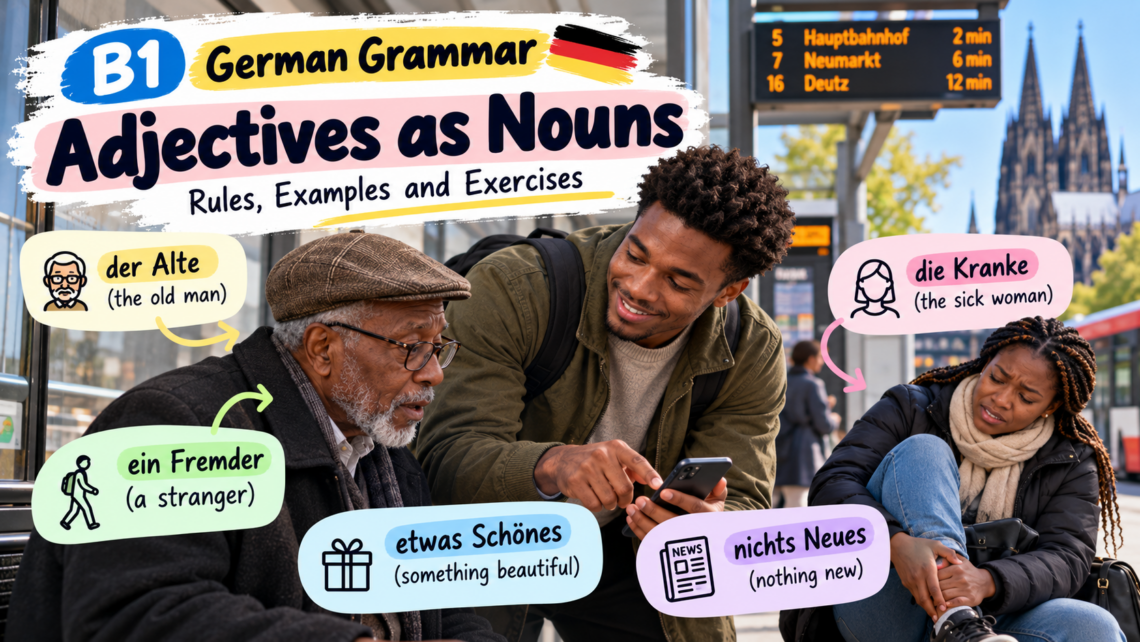
B1 German Grammar: Adjectives as Nouns (Nominalisierte Adjektive) – Rules, Examples and Exercises
Have you ever seen German expressions such as der Alte, die Kranke or das Gute and wondered why an adjective suddenly looks like a noun?
At B1 level, you need to understand how German adjectives can be used as nouns. This structure is called Nominalisierung von Adjektiven, and it is common in everyday conversations, newspaper articles, formal texts and German examinations.
In this lesson, you will learn how to turn adjectives into nouns, how to use the correct articles and adjective endings, and how to avoid common mistakes. We will also continue following Tom as he builds his confidence in German and learns to describe people and situations more precisely.
If you are preparing for your Goethe, telc or ÖSD B1 examination, this lesson will help you improve your reading, writing and speaking skills.
1. What Are Adjectives Used as Nouns in German?
In German, adjectives usually describe nouns.
For example:
- der alte Mann – the old man
- die kranke Frau – the sick woman
- etwas Gutes – something good
- ein Fremder – a stranger
However, sometimes we do not need to mention the noun because its meaning is already clear. In such cases, we can use the adjective itself as a noun.
Compare these sentences:
Without nominalisation:
Der alte Mann wartet vor dem Haus.
(The old man is waiting in front of the house.)
With nominalisation:
Der Alte wartet vor dem Haus.
(The old man is waiting in front of the house.)
In the second sentence, Mann is omitted. The adjective alt becomes a noun and is written with a capital letter: der Alte.
More examples
| Adjective + noun | Nominalised adjective | English |
|---|---|---|
| der alte Mann | der Alte | the old man |
| die kranke Frau | die Kranke | the sick woman |
| der deutsche Student | der Deutsche | the German man/student |
| die arbeitslose Frau | die Arbeitslose | the unemployed woman |
| etwas Schönes | etwas Schönes | something beautiful |
| nichts Neues | nichts Neues | nothing new |
Important rule: Nominalised adjectives are written with a capital letter because they function as nouns.
If you need to review the ordinary forms of German adjectives first, read our guide to German adjective declension, comparatives and superlatives.
2. How Do You Form Nominalised Adjectives?
The adjective does not usually change its basic meaning. Instead, it receives an appropriate ending depending on the article, grammatical case and context.
Consider the adjective alt.
- der alte Mann → der Alte
- die alte Frau → die Alte
- das alte Gebäude → das Alte
Notice that the endings depend on the grammatical structure.
Nominalised adjectives with definite articles
When you use a definite article such as der, die or das, the adjective takes an ending appropriate to the gender and case.
| Case | Masculine | Feminine | Neuter |
|---|---|---|---|
| Nominativ | der Alte | die Alte | das Gute |
| Akkusativ | den Alten | die Alte | das Gute |
| Dativ | dem Alten | der Alten | dem Guten |
| Genitiv | des Alten | der Alten | des Guten |
These forms are particularly useful when the person or thing is already known from the context.
Examples:
- Der Alte wohnt nebenan.
The old man lives next door. - Ich besuche den Alten morgen.
I am visiting the old man tomorrow. - Ich helfe der Kranken.
I am helping the sick woman. - Wir sprechen mit dem Fremden.
We are talking to the stranger.
Remember that the article and the adjective ending work together. Always identify the case before choosing the correct form.
For more practice with the German cases, read our guide to German nominative, accusative, dative and genitive.
3. Nominalised Adjectives with Indefinite Articles
Nominalised adjectives can also appear with indefinite articles such as ein and eine.
Examples:
- ein Fremder – a male stranger
- eine Fremde – a female stranger
- ein Bekannter – a male acquaintance
- eine Bekannte – a female acquaintance
Look at these sentences:
- Ein Fremder hat mich nach dem Weg gefragt.
A stranger asked me for directions. - Eine Bekannte besucht uns heute.
A female acquaintance is visiting us today. - Ich habe einen Bekannten im Bahnhof getroffen.
I met a male acquaintance at the train station. - Sie hilft einer Bedürftigen.
She is helping a woman in need.
Notice how the adjective ending changes according to the article and grammatical case.
Common nominalised adjectives describing people
| Masculine | Feminine | English |
|---|---|---|
| ein Bekannter | eine Bekannte | an acquaintance |
| ein Fremder | eine Fremde | a stranger |
| ein Arbeitsloser | eine Arbeitslose | an unemployed person |
| ein Erwachsener | eine Erwachsene | an adult |
| ein Verletzter | eine Verletzte | an injured person |
| ein Deutscher | eine Deutsche | a German person |
These expressions are especially useful when describing people without repeating a noun.
4. Nominalised Adjectives After etwas, nichts, viel and wenig
One of the most useful patterns at B1 level involves words such as:
- etwas – something
- nichts – nothing
- viel – much/a lot
- wenig – little
- alles – everything
When an adjective follows these expressions and is used as a noun, it usually takes the ending -es.
Examples:
- etwas Schönes – something beautiful
- etwas Interessantes – something interesting
- nichts Neues – nothing new
- nichts Wichtiges – nothing important
- viel Gutes – much good
- wenig Interessantes – little that is interesting
- alles Gute – all the best/everything good
Notice the difference between etwas Gutes and alles Gute. The ending depends on the expression used.
Example sentences
- Ich habe heute etwas Interessantes gelesen.
I read something interesting today. - Es gibt nichts Neues zu berichten.
There is nothing new to report. - Wir wünschen dir alles Gute zum Geburtstag.
We wish you all the best for your birthday. - Sie hat viel Schönes erlebt.
She has experienced many beautiful things. - Hast du etwas Wichtiges vergessen?
Did you forget something important?
Exam tip: Expressions such as etwas Wichtiges, nichts Neues and alles Gute are common in everyday German and are useful for B1 writing and speaking tasks.
5. Nominalised Adjectives in the Comparative and Superlative
You can also nominalise comparative and superlative forms.
Examples:
- der Ältere – the older man/person
- die Jüngere – the younger woman/person
- der Beste – the best man/person
- die Schnellste – the fastest woman/person
- das Wichtigste – the most important thing
Compare:
Tom ist jünger als sein Kollege.
(Tom is younger than his colleague.)
Tom ist der Jüngere von beiden.
(Tom is the younger one of the two.)
Another example:
Das ist das Wichtigste.
(That is the most important thing.)
You can revise comparative and superlative forms in Lesson 8: Comparatives, Superlatives and außer + Dativ.
6. Common Mistakes with Nominalised Adjectives
Even intermediate learners sometimes forget capitalization or use the wrong adjective ending.
Mistake 1: Forgetting capitalization
❌ Ich habe etwas interessantes gelesen.
✅ Ich habe etwas Interessantes gelesen.
Interessantes is used as a noun, so it begins with a capital letter.
Mistake 2: Using the wrong case ending
❌ Ich helfe dem Alte.
✅ Ich helfe dem Alten.
The verb helfen requires the dative case. Therefore, we say dem Alten.
Mistake 3: Forgetting the adjective ending after an article
❌ Der Alt wartet vor dem Haus.
✅ Der Alte wartet vor dem Haus.
The nominalised adjective needs the appropriate ending.
Mistake 4: Confusing the adjective with the noun
❌ Sie hat etwas schön gekauft.
✅ Sie hat etwas Schönes gekauft.
The adjective follows etwas and is used as a noun, so it takes the ending -es.
7. Tom’s Story: Eine unerwartete Begegnung
In the previous chapter, Tom was learning how to compare people, situations and experiences using comparative and superlative forms. He was also discovering that small improvements in his German could make everyday conversations easier.
You can revisit the previous lesson here: Lesson 8: Comparatives, Superlatives and außer + Dativ.
Now, Tom is ready to put his German into practice in a real situation.
Tom hilft einem Fremden
Es ist Samstagmorgen. Tom geht in die Stadt, weil er ein Geschenk für einen Freund kaufen möchte. Auf dem Weg zum Einkaufszentrum sieht er einen älteren Mann, der vor einer Bushaltestelle steht und unsicher auf sein Handy schaut.
Tom bemerkt, dass der Mann Schwierigkeiten hat, die richtige Verbindung zu finden.
„Entschuldigung, kann ich Ihnen helfen?“, fragt Tom freundlich.
Der Mann lächelt erleichtert. „Ja, bitte. Ich suche den Bahnhof, aber ich weiß nicht, welchen Bus ich nehmen muss.“
Tom schaut auf den Fahrplan und erklärt ihm den Weg. Dabei bemerkt er eine Frau, die auf einer Bank sitzt und sich den Knöchel hält.
„Geht es Ihnen gut?“, fragt Tom.
„Nicht besonders. Ich bin gestürzt“, antwortet die Frau.
Tom bietet ihr an, Hilfe zu holen. Ein anderer Passant ruft den Rettungsdienst, während Tom bei der Frau bleibt.
Nach einigen Minuten kommt ein Mitarbeiter des Rettungsdienstes. Er untersucht die Verletzte und stellt fest, dass sie ärztlich untersucht werden sollte.
Der ältere Mann bedankt sich bei Tom, bevor er seinen Bus nimmt.
„Sie haben heute zwei Menschen geholfen“, sagt ein Passant. „Das war wirklich freundlich von Ihnen.“
Tom lächelt. „Ich habe nur getan, was ich konnte. Manchmal braucht man einfach jemanden, der hilft.“
Auf dem Heimweg denkt Tom über die Begegnung nach. Er merkt, wie viel einfacher es ihm inzwischen fällt, auf Deutsch mit fremden Menschen zu sprechen.
Je öfter Tom solche Gespräche führt, desto sicherer wird er im Umgang mit anderen Menschen.
Er ist stolz auf sich. Früher hätte er vielleicht gezögert, aber heute konnte er einem Fremden den Weg erklären und einer Verletzten helfen.
Tom erkennt, dass es beim Deutschlernen nicht nur darum geht, grammatisch richtige Sätze zu bilden. Es geht auch darum, die Sprache im echten Leben zu benutzen.
Vocabulary from Tom’s Story
| German | English |
|---|---|
| der Fremde / die Fremde | the stranger |
| der Ältere / die Ältere | the older person |
| der Passant / die Passantin | the passer-by |
| der Verletzte / die Verletzte | the injured person |
| erleichtert | relieved |
| der Fahrplan | timetable |
| der Rettungsdienst | emergency medical service |
| der Knöchel | ankle |
| stürzen | to fall |
| sich bedanken | to thank |
| zögern | to hesitate |
| im Umgang mit anderen | when interacting with others |
Grammar in Tom’s Story
Look at the nominalised adjectives in the story:
- einen älteren Mann — Here, älteren describes the noun Mann. It is not nominalised.
- den älteren Mann — Again, älteren is an adjective describing Mann.
- die Verletzte — Here, the noun is omitted, and the adjective becomes a noun.
- einem Fremden — The adjective is used as a noun in the dative case.
The last two examples show how nominalised adjectives help us avoid repeating words such as Frau, Mann or Person.
8. B1 German Grammar Exercises: Nominalisierte Adjektive
Now it is your turn! Complete the exercises before checking the answers.
Exercise A: Complete the sentences
Write the correct nominalised adjective in each gap.
- Der alte Mann ist freundlich. ______ hilft mir oft. (alt)
- Ich habe heute etwas ______ gelesen. (interessant)
- Wir helfen dem ______. (verletzt)
- Sie spricht mit einer ______ aus Berlin. (bekannt)
- Ich wünsche dir alles ______ zum Geburtstag. (gut)
Exercise B: Rewrite the sentences
Rewrite each sentence using a nominalised adjective.
- Der alte Mann wartet vor dem Haus.
- Die kranke Frau braucht Hilfe.
- Ich habe eine interessante Sache gelesen.
- Ein fremder Mann hat nach dem Weg gefragt.
- Das Wichtigste ist, dass du gesund bleibst.
Exercise C: Correct the mistakes
Each sentence contains one mistake. Rewrite it correctly.
- Ich habe etwas schönes gekauft.
- Ich helfe dem Verletzte.
- Der alt wohnt nebenan.
- Wir haben nichts neues gehört.
- Eine Bekannter besucht mich morgen.
Exercise D: Speaking practice
Answer the following questions in German. Try to use nominalised adjectives in your answers.
- Hast du heute etwas Interessantes erlebt?
- Was ist für dich das Wichtigste beim Deutschlernen?
- Hast du schon einmal einem Fremden geholfen?
- Was wünschst du einem Freund zum Geburtstag?
- Was kannst du tun, um einem Verletzten zu helfen?
Try to answer in complete sentences and explain your reasons where possible.
9. Answers to the Exercises
Exercise A
- Der Alte hilft mir oft.
- Ich habe heute etwas Interessantes gelesen.
- Wir helfen dem Verletzten.
- Sie spricht mit einer Bekannten aus Berlin.
- Ich wünsche dir alles Gute zum Geburtstag.
Exercise B — Sample answers
- Der Alte wartet vor dem Haus.
- Die Kranke braucht Hilfe.
- Ich habe etwas Interessantes gelesen.
- Ein Fremder hat nach dem Weg gefragt.
- Das Wichtigste ist, dass du gesund bleibst.
Exercise C
- Ich habe etwas Schönes gekauft.
- Ich helfe dem Verletzten.
- Der Alte wohnt nebenan.
- Wir haben nichts Neues gehört.
- Ein Bekannter besucht mich morgen.
10. Writing Practice: Helping Someone in Need
Imagine that you see someone who needs help on your way to work, school or the supermarket.
Write a short text of approximately 80–100 words in German about the situation.
Include the following information:
- Who needed help?
- What happened?
- What did you do?
- How did the person react?
- How did you feel afterwards?
Try to include at least three nominalised adjectives, such as der Fremde, die Verletzte, etwas Gutes, nichts Neues or das Wichtigste.
Example opening:
Gestern habe ich einem Fremden geholfen. Der Mann hatte sich verlaufen und wusste nicht, wie er zum Bahnhof kommen sollte. Zuerst habe ich …
11. Continue Your B1 German Grammar Journey
You have now learned how German adjectives can function as nouns, how to choose their endings and how to use them in everyday situations.
Continue exploring the B1 grammar series:
- Lesson 1: um … zu and ohne … zu — express purposes and actions that happen without another action.
- Lesson 2: Verbs with Prepositions and Pronominal Adverbs — practise expressions such as warten auf, darauf and daran.
- Lesson 3: wegen and trotz + Genitiv — give reasons and express contrast.
- Lesson 4: da and falls — explain causes and conditions.
- Lesson 5: seit, seitdem and bis — describe time relationships.
- Lesson 6: indem — explain how an action is carried out.
- Lesson 7: je … desto / umso — compare changes and results.
- Lesson 8: Comparatives, Superlatives and außer + Dativ — compare people and situations and describe exceptions.
Before publishing, replace any placeholder links marked with # with the corresponding published article URLs.
12. Learn B1 German Online with Learn German with Frau Kolb
Would you like to improve your German grammar without feeling overwhelmed?
Our B1 German online course helps you build your grammar and communication skills through structured lessons and practical activities. Study at your own pace with video lessons, interactive eBooks, downloadable PDFs, audio materials, self-assessment tests and exam practice.
Whether you are preparing for the Goethe, telc or ÖSD B1 examination or simply want to communicate more confidently in German, consistent practice can help you make progress.
Explore Learn German with Frau Kolb and take the next step towards more confident German.


You May Also Like

B1 German: da vs weil vs falls (Explained with Examples & Story)
A1 German Articles Explained