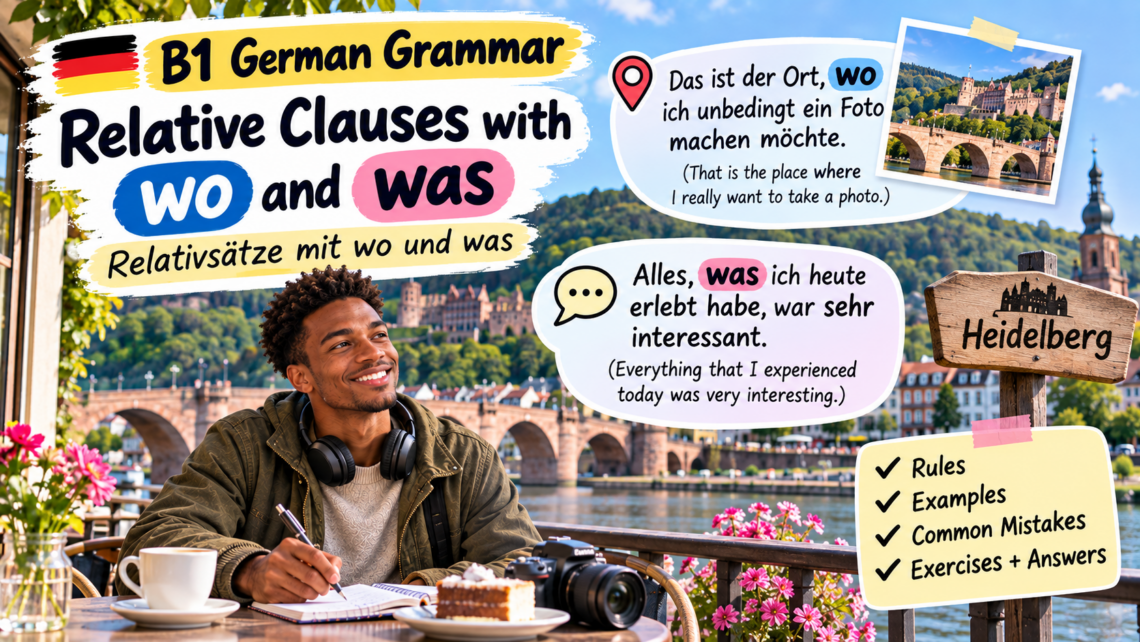
B1 German Grammar: Relative Clauses with wo and was – Rules, Examples and Exercises
Have you ever wanted to describe a place you visited, something interesting that happened to you, or an experience you cannot easily explain in one sentence?
In German, relative clauses help you connect ideas and give more information without making your sentences sound repetitive. At B1 level, it is important to understand not only relative pronouns such as der, die, and das, but also the special uses of wo and was.
In this lesson, you will learn:
- When to use wo in relative clauses.
- When to use was instead of der, die, or das.
- How to use was after words such as alles, etwas, and nichts.
- How was can refer to an entire previous statement.
- Common mistakes and how to avoid them.
- How to use these structures in everyday conversations and B1 exam tasks.
If you need to revise basic German vocabulary before working with longer descriptions, start with our guide to A1 German vocabulary topics.
1. What Are Relative Clauses (Relativsätze)?
A relative clause gives us additional information about a person, place, thing, or situation. It is connected to a main clause and usually begins with a relative pronoun.
Compare these two sentences:
Without a relative clause:
Ich kenne eine Frau. Sie arbeitet im Krankenhaus.
(I know a woman. She works in a hospital.)
With a relative clause:
Ich kenne eine Frau, die im Krankenhaus arbeitet.
(I know a woman who works in a hospital.)
The second sentence sounds more natural because we have combined the two ideas.
At B1 level, you should already be familiar with relative pronouns such as:
- der – masculine
- die – feminine
- das – neuter
- den – masculine accusative
- dem – masculine/neuter dative
- denen – plural dative
If you need to revise how German prepositions work with locations, our lesson on A2 Wechselpräpositionen explained simply will help you understand the relationship between prepositions, cases and places.
Today, we are concentrating on two other words: wo and was.
2. When Do We Use „wo“ in Relative Clauses?
We use wo to refer to a place or location that has already been mentioned.
It is similar to the English words where or in which.
Examples
- Das ist das Restaurant, wo wir gestern gegessen haben.
(That is the restaurant where we ate yesterday.) - Ich möchte in einer Stadt wohnen, wo es viele Arbeitsmöglichkeiten gibt.
(I would like to live in a city where there are many job opportunities.) - Kennst du den Park, wo die Kinder spielen?
(Do you know the park where the children play?)
Notice that wo refers to a place: das Restaurant, einer Stadt, and den Park.
Important: „wo“ or „in der“?
Although wo is commonly used in everyday spoken German, it is often better to use a relative pronoun with the appropriate preposition in formal or written German.
Compare:
- Das ist die Stadt, wo ich geboren bin.
- Das ist die Stadt, in der ich geboren bin.
Both are understandable. However, „in der“ is generally the more precise and formal construction.
More examples:
- Das ist das Haus, in dem meine Grosseltern früher gewohnt haben.
(That is the house in which my grandparents used to live.) - Ich besuche die Schule, an der meine Mutter früher gearbeitet hat.
(I am visiting the school where my mother used to work.) - Das ist der Ort, an dem wir uns kennengelernt haben.
(That is the place where we met.)
B1 exam tip: In formal writing, prefer constructions such as in dem, in der, an dem, or an der when the required preposition and case are clear. Use wo naturally in less formal contexts.
3. When Do We Use „was“ in Relative Clauses?
The relative pronoun was is used in particular situations. It does not normally refer directly to an ordinary masculine, feminine or neuter noun.
There are three important situations to remember.
A. After „alles“, „etwas“, „nichts“ and similar expressions
We use was after indefinite expressions such as:
- alles (everything)
- etwas (something)
- nichts (nothing)
- vieles (many things)
- wenig (little)
Examples:
- Alles, was du sagst, ist wichtig.
(Everything you say is important.) - Ich habe etwas gefunden, was dir gefallen könnte.
(I found something that you might like.) - Es gibt nichts, was mich heute überraschen könnte.
(There is nothing that could surprise me today.) - Sie hat vieles erlebt, was sie nie vergessen wird.
(She has experienced many things that she will never forget.)
Remember: after these expressions, was introduces the additional information.
B. After the demonstrative pronoun „das“
We can use was after the demonstrative pronoun das when it means that or the thing that.
Examples:
- Das, was du gerade gesagt hast, stimmt.
(What you just said is correct.) - Das ist genau das, was ich gesucht habe.
(That is exactly what I was looking for.) - Ich verstehe nicht das, was er meint.
(I do not understand what he means.)
A more natural version of the last sentence would often be:
Ich verstehe nicht, was er meint.
C. When „was“ refers to an entire previous statement
This is particularly useful at B1 level.
Sometimes was does not refer to one particular noun. Instead, it refers to the meaning of an entire sentence or statement that came before it.
Examples:
- Er hat die Prüfung bestanden, was mich sehr gefreut hat.
(He passed the exam, which made me very happy.) - Sie hat ihre Arbeit verloren, was für sie sehr schwierig war.
(She lost her job, which was very difficult for her.) - Wir haben den letzten Zug verpasst, was ziemlich ärgerlich war.
(We missed the last train, which was quite annoying.)
In these examples, was refers to the whole situation described in the first part of the sentence.
This structure is especially useful when expressing reactions, opinions and consequences.
4. Word Order in Relative Clauses
One important rule applies to both wo and was:
The conjugated verb goes to the end of the relative clause.
Examples:
- Das ist der Ort, wo wir uns getroffen haben.
- Alles, was du mir erzählt hast, ist interessant.
- Er hat die Prüfung bestanden, was mich sehr gefreut hat.
Compare the word order:
| Main clause | Relative clause |
|---|---|
| Wir haben dort gegessen. | wo wir gegessen haben |
| Du hast etwas gesagt. | was du gesagt hast |
| Sie hat die Prüfung bestanden. | was mich gefreut hat |
This is the same verb-final principle you have already encountered in subordinate clauses. If you need a refresher, revisit our A2 lesson on giving advice and talking about conditions with wenn and sollte.
5. Common Mistakes with „wo“ and „was“
Let’s look at mistakes German learners often make.
Mistake 1: Using „wo“ for every place
Incorrect or less suitable in formal writing:
Das ist die Stadt, wo ich geboren bin.
More formal and precise:
Das ist die Stadt, in der ich geboren bin.
Remember: In formal writing, use the appropriate preposition and relative pronoun where possible.
Mistake 2: Using „was“ after an ordinary noun
Incorrect:
Das ist das Buch, was ich gekauft habe.
Correct:
Das ist das Buch, das ich gekauft habe.
Why? Because das Buch is a specific noun. We use das, not was, to refer back to it.
Mistake 3: Forgetting the verb at the end
Incorrect:
Alles, was du gesagt hast, ist wichtig.
Correct:
Alles, was du gesagt hast, ist wichtig.
The example above is already correct. Notice that hast is at the end of the relative clause, before the main clause continues.
Another incorrect example:
Das ist der Ort, wo wir haben uns getroffen.
Correct:
Das ist der Ort, wo wir uns getroffen haben.
Mistake 4: Confusing „was“ with „das“
Incorrect:
Alles, das du brauchst, ist hier.
Correct:
Alles, was du brauchst, ist hier.
Remember this useful distinction:
- das refers to a specific noun: das Buch, das ich lese
- was often follows indefinite expressions: alles, was ich brauche
6. Tom’s Story: Ein Ort voller Erinnerungen
Let’s follow Tom as he continues his journey in Germany.
Tom had spent the previous weekend in Heidelberg. He had always wanted to visit the city because he had heard so much about its historic buildings, beautiful streets and famous castle.
On Saturday morning, he decided to explore the old town.
Ein besonderer Samstag in Heidelberg
Tom stand vor einem kleinen Café in der Altstadt. Es war ein Ort, wo sich viele Menschen trafen, um Kaffee zu trinken und miteinander zu sprechen.
Er bestellte einen Kaffee und setzte sich an einen Tisch am Fenster.
Neben ihm sass eine ältere Frau, die ein Buch las. Tom bemerkte, dass sie eine Karte von Heidelberg auf dem Tisch liegen hatte.
„Entschuldigung“, fragte Tom freundlich. „Können Sie mir vielleicht sagen, wo das Schloss ist?“
Die Frau lächelte.
„Natürlich! Das Schloss ist einer der schönsten Orte hier. Es gibt vieles, was Sie dort entdecken können.“
Tom bedankte sich und begann ein Gespräch mit ihr. Sie erzählte ihm, dass sie schon seit vielen Jahren in Heidelberg lebte und die Stadt sehr gut kannte.
„Wissen Sie“, sagte sie, „es gibt nichts, was ich an dieser Stadt nicht mag. Besonders schön finde ich die alten Gebäude und die kleinen Gassen.“
Tom hörte aufmerksam zu. Er erzählte ihr, dass er erst seit einiger Zeit in Deutschland lebte und noch viele Orte kennenlernen wollte.
Die Frau zeigte auf die Karte.
„Dort oben ist das Schloss. Und das ist der Weg, den Sie nehmen sollten. Sie werden eine wunderschöne Aussicht haben.“
Tom bedankte sich herzlich und machte sich auf den Weg.
Als er später vor dem Schloss stand, war er beeindruckt. Die Aussicht über die Stadt war wunderschön. Er machte viele Fotos und dachte daran, wie viel er in den letzten Monaten gelernt hatte.
Er hatte neue Menschen kennengelernt, neue Orte besucht und viele Erfahrungen gesammelt, die er nie vergessen würde.
Am Abend schrieb er in sein Tagebuch:
„Heidelberg ist eine Stadt, die ich unbedingt noch einmal besuchen möchte. Es gibt so vieles, was ich heute erlebt habe. Besonders schön war das Gespräch mit der älteren Frau, was meinen Tag noch interessanter gemacht hat.“
Vocabulary from the Story
| German | English |
|---|---|
| die Altstadt | old town |
| das Schloss | castle |
| die Gasse | alley |
| die Aussicht | view |
| entdecken | to discover |
| aufmerksam | attentive |
| sich bedanken | to thank |
| die Erfahrung | experience |
| beeindruckt sein | to be impressed |
| das Tagebuch | diary |
Notice the grammar in Tom’s story:
- ein Ort, wo sich viele Menschen trafen – wo refers to a place.
- vieles, was Sie dort entdecken können – was follows vieles.
- nichts, was ich an dieser Stadt nicht mag – was follows nichts.
- Erfahrungen, die er nie vergessen würde – die refers to the plural noun Erfahrungen.
- was meinen Tag noch interessanter gemacht hat – was refers to the previous statement.
You can also practise describing places, people and everyday experiences with our A2 lesson on talking about food and eating habits. It provides useful vocabulary for describing everyday situations like Tom’s café visit.
7. Exercises: Practise „wo“ and „was“
Now it is your turn. Complete the following exercises to check whether you understand the difference between wo and was.
Exercise 1: Fill in the gaps
Complete the sentences with wo, was, der, die or das.
- Das ist das Restaurant, ______ wir gestern gegessen haben.
- Alles, ______ du brauchst, findest du hier.
- Das ist die Frau, ______ neben mir wohnt.
- Es gibt nichts, ______ ich heute kaufen möchte.
- Heidelberg ist eine Stadt, ______ viele Touristen besuchen.
- Das ist genau das, ______ ich gesucht habe.
- Ich kenne einen Ort, ______ man sehr gut spazieren gehen kann.
- Das ist das Buch, ______ ich letzte Woche gekauft habe.
- Er hat die Prüfung bestanden, ______ mich sehr gefreut hat.
- Kennst du den Mann, ______ dort arbeitet?
Exercise 2: Combine the sentences
Join the two sentences using an appropriate relative pronoun.
Example:
Ich habe etwas gesehen. Es war sehr interessant.
→ Ich habe etwas gesehen, was sehr interessant war.
- Das ist ein Café. Wir treffen uns dort oft.
- Ich habe alles gelesen. Du hast es mir geschickt.
- Sie hat eine neue Arbeit gefunden. Das hat ihre Familie sehr gefreut.
- Das ist die Schule. Mein Bruder hat dort gelernt.
- Er hat nichts gesagt. Das hätte uns helfen können.
- Ich kenne eine Frau. Sie arbeitet in einer Apotheke.
- Wir haben einen schönen Urlaub gemacht. Das war eine tolle Erfahrung.
- Das ist das Hotel. Wir haben dort übernachtet.
Exercise 3: Correct the mistakes
Each sentence contains one mistake. Rewrite it correctly.
- Alles, das ich brauche, ist in meiner Tasche.
- Das ist die Stadt, wo ich geboren bin. (Rewrite in a more formal style.)
- Er hat mir geholfen, was ich sehr dankbar bin.
- Das ist das Buch, was ich gestern gekauft habe.
- Das ist der Ort, wo wir haben uns kennengelernt.
8. Answer Key
Exercise 1
- wo
- was
- die
- was
- die
- was
- wo
- das
- was
- der
Note on number 5: Heidelberg ist eine Stadt, die viele Touristen besuchen. Here, die is the accusative relative pronoun referring to eine Stadt. The sentence means that tourists visit the city.
Exercise 2
Possible answers:
- Das ist ein Café, wo wir uns oft treffen.
- Ich habe alles gelesen, was du mir geschickt hast.
- Sie hat eine neue Arbeit gefunden, was ihre Familie sehr gefreut hat.
- Das ist die Schule, an der mein Bruder gelernt hat.
- Er hat nichts gesagt, was uns hätte helfen können.
- Ich kenne eine Frau, die in einer Apotheke arbeitet.
- Wir haben einen schönen Urlaub gemacht, was eine tolle Erfahrung war.
- Das ist das Hotel, in dem wir übernachtet haben.
Exercise 3
- Alles, was ich brauche, ist in meiner Tasche.
- Das ist die Stadt, in der ich geboren bin.
- Er hat mir geholfen, wofür ich ihm sehr dankbar bin.
- Das ist das Buch, das ich gestern gekauft habe.
- Das ist der Ort, an dem wir uns kennengelernt haben.
Important: In Exercise 3, number 3 requires a different construction. We say wofür ich ihm sehr dankbar bin (for which I am very grateful to him), not was ich sehr dankbar bin.
9. Writing Practice: Describe a Place You Have Visited
Write a short text of approximately 100–120 words about a place you have visited.
You can write about a city, a restaurant, a park, a school or another place that made an impression on you.
Try to include:
- At least two relative clauses with wo or a formal alternative such as in dem or in der.
- At least two relative clauses with was.
- One sentence in which was refers to an entire previous statement.
- Your personal opinion about the place.
Useful sentence starters
- Das ist ein Ort, wo …
- Ich war einmal in einer Stadt, in der …
- Es gibt vieles, was …
- Alles, was ich dort gesehen habe, …
- Besonders interessant war …, was …
10. Speaking Practice: Ein Ort, den ich nie vergessen werde
Work with a partner or practise speaking on your own.
Part 1: Describe a place
Talk about a place you have visited and explain:
- Where it is.
- What people can do there.
- Why you remember it.
- What you liked or disliked about it.
Part 2: Give your opinion
Discuss these questions:
- Gibt es einen Ort, wo du dich besonders wohlfühlst?
- Was ist das Schönste, was du bisher in Deutschland erlebt hast?
- Gibt es etwas, was du unbedingt noch lernen möchtest?
- Welche Stadt würdest du gern besuchen und warum?
- Was war das Interessanteste, was du in den letzten Monaten erlebt hast?
B1 speaking tip: Do not answer every question with a single sentence. Give a reason, add an example and explain your experience. Relative clauses help you connect your ideas and demonstrate a wider range of grammar.
11. Quick Grammar Summary: „wo“ vs. „was“
| Structure | When to use it | Example |
|---|---|---|
| wo | Refers to a place in everyday language | Das ist der Ort, wo wir uns trafen. |
| in dem / in der | Refers to a place more precisely, especially in formal writing | Das ist die Stadt, in der ich lebe. |
| was | After alles, etwas, nichts, vieles and similar expressions | Alles, was du sagst, ist wichtig. |
| was | After demonstrative das | Das ist genau das, was ich wollte. |
| was | Refers to an entire previous statement | Er kam zu spät, was mich ärgerte. |
| der / die / das | Refers to a specific noun | Das ist das Buch, das ich lese. |
Remember these three rules:
- Use wo when referring to a place, especially in everyday spoken German. In formal writing, choose a precise construction such as in dem or in der where appropriate.
- Use was after expressions such as alles, etwas, nichts, and vieles, and when referring to a whole previous statement.
- In relative clauses, the conjugated verb goes to the end.
12. Continue Learning: Your Next B1 Grammar Lesson
Well done! You have now learned how to use wo and was in German relative clauses.
These structures help you describe places, explain experiences and connect ideas more naturally. They are particularly useful in B1 writing and speaking tasks, where you need to express yourself with more detail.
Continue practising by revisiting the A2 lessons linked throughout this article, especially those covering prepositions, past experiences and subordinate clauses. Building on these foundations will make the transition to B1 grammar much easier.
In the next lesson, we will take relative clauses one step further:
B1 German Grammar: Relative Clauses with Prepositions (Relativsätze mit Präpositionen)
You will learn how to combine prepositions and relative pronouns correctly, for example:
- Das ist der Kollege, mit dem ich zusammenarbeite.
- Das ist die Frau, auf die ich gewartet habe.
- Das ist das Thema, über das wir gesprochen haben.
Keep practising, and remember: the more you use these structures, the more natural your German will become!
Take Your German to the Next Level with Our B1 Course
Would you like to improve your German grammar, expand your vocabulary and become more confident in speaking and writing?
Join our Unlocking German B1 Mastery course at Learn German with Frau Kolb.
The course helps you strengthen your B1 German skills through structured lessons, practical exercises and guided learning. Whether you are preparing for a German language examination or simply want to communicate more confidently in everyday life, it is a great next step in your learning journey.
Start your B1 German learning journey today!

You May Also Like

B1 German: How to Use „seit“, „seitdem“ and „bis“ (Explained with Examples & Story)

B1 German Grammar: Comparatives, Superlatives and „Außer + Dativ“ (With Examples and Exercises)